The Palette/black/Made in a lab or a works
Lamp black
Collected soot. The oldest manufactured pigment, the base of Indian ink and Chinese ink, and still the black in your printer and your tyres.
Also called carbon black · soot black · kajal · sumi
- Hex
- #211F1E
- RGB
- 33, 31, 30
- Pigment index
- PBk7
- First used
- At least 30,000 years as charcoal; lamp black by the ancient period
- From
- Everywhere there has been a flame
What it is
Nearly pure carbon, as very fine particles.
How it is made
Burn something oily with insufficient air and collect the smoke on a cold surface. That is lamp black, and the method has not changed in principle in three thousand years: the Chinese ink industry burned tung oil or pine under inverted funnels, the Indian industry burned ghee and oils, and the modern furnace-black industry burns hydrocarbon feedstock at scale.
For ink the soot is bound with animal glue and, in the Chinese and Japanese traditions, worked into sticks with enormous care: kneaded, moulded, dried for months, sometimes perfumed. A good inkstick is a manufactured object of real sophistication that looks like a lump of coal.
Charcoal and bone black are the other two routes to black: charcoal from burning wood with no air, bone black from calcining bones. All three are carbon, and they are noticeably different colours.
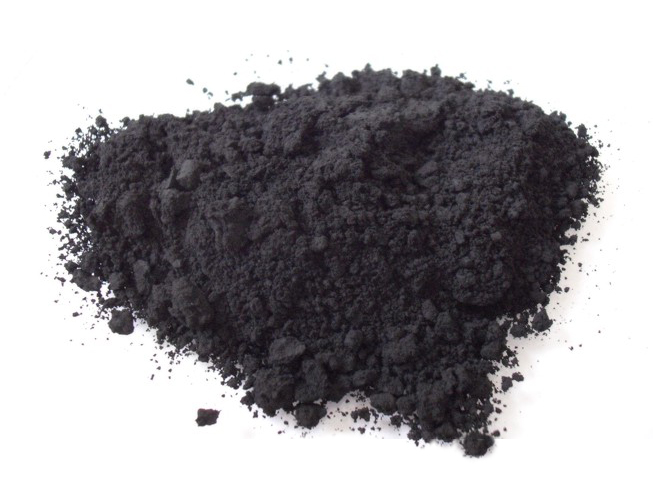
Lamp black, Chemical compound. Wikipedia's description, not ours.
The history
This is the pigment of writing. Egyptian, Chinese, Indian and Roman inks are carbon in a binder, and carbon inks are the reason two-thousand-year-old manuscripts are still legible, carbon is chemically inert, so it does not fade, and unlike the iron-gall inks that replaced it in Europe it does not eat the paper.
The Chinese and Japanese ink traditions took it furthest, and sumi-e painting is entirely a study of what one pigment can do when the only variables are dilution, paper and speed. It is worth doing once, because it teaches value in a way that no amount of colour theory does: with one black and some water you have every tone available and nowhere to hide.
Its industrial scale now is enormous and almost invisible. Carbon black is one of the highest-volume chemicals in the world, and most of it goes into tyres as a reinforcing filler rather than as a colourant. Car tyres are black because carbon black makes rubber last several times longer, which is why nobody sells white ones.
Where it is used
Ink, printing, painting, kajal and kohl, tyres, plastics, and toner. Also every black on every screen, in the sense that it is what the reference is.
In a palette, carbon blacks are cool and slightly blue, bone black is browner and warmer, and the difference is visible the moment you put them side by side. Almost nobody choosing 'black' for a brand knows which of these they mean, and the answer changes how the whole palette reads. A warm black with a warm paper is a coherent object; a cool black on a warm paper reads as a mistake.
Go and look at it
The Dead Sea Scrolls and Egyptian papyri
Israel Museum, Jerusalem; British Museum, London
Carbon ink, still black after two thousand years. Compare with a medieval iron-gall manuscript eating itself.
Any sumi-e or Chinese ink painting
Palace Museum, Beijing; the Met, New York
One pigment, one brush, water as the only modifier. The whole tonal range from a single black.
How it behaves
- Made of
- Nearly pure carbon, as very fine particles.
- Opacity
- Opaque. It covers what is under it.
- Lightfastness
- Permanent. It will outlive the thing it is painted on.
- Chemically inert and completely permanent. Carbon ink does not fade or attack paper.
- Cool and slightly blue compared with bone black.
- Very slow drying in oil. One of the slowest pigments there is.
The numbers
All derived from the hex, never typed beside it
- HEX
- #211F1E
- What a browser and a design file want.
- RGB
- 33, 31, 30
- The same three numbers in base ten. Light, not ink.
- HSL
- 20°, 5%, 12%
- Hue, saturation, lightness, how a person describes a colour.
- CMYK
- 0, 6, 9, 87
- Arithmetic only. A real separation depends on the press, the paper and a profile.
- LAB
- 12, 1, 1
- Perceptual. L* of 12 is how light this actually looks, which HSL gets wrong.
This hex is an approximation, and a page about pigment has to say so. Lamp black is a substance. A ground mineral scatters light from thousands of separate grains at slightly different angles, and no single sRGB value is that event. It is a flat average of a photograph of it, and the real thing is outside what a screen can emit. Use the number to specify a screen colour. Do not use it to judge the pigment.
Where it sits on the wheel
Hue 20°
Its opposite, by the diagram
The arithmetic opposite, 180° round in HSL. Useful, and not the same as the opposite a painter mixing pigment would name, that wheel was built for paint.
Lighter and darker
Towards white
Mixing with white does not only lighten, it dulls and cools. This is why a pale tint of a brand colour so often looks chalky, and why a designed light shade beats a generated one.
Towards black
Mixing with black kills the hue as it darkens. A better dark is usually the colour plus its neighbour round the wheel, which is what every painter does instead.
Can you set type on it
Handgloves
White on it
16.41:1 · AAA
Handgloves
Black on it
1.28:1 · Fails
Handgloves
It on paper
15.58:1 · AAA
Handgloves
It on ink
1.11:1 · Fails
4.5:1 is the floor for body text and 3:1 for large text, by WCAG. Treat it as a minimum you may not go under rather than as a target: plenty of pairs pass at 4.6:1 and are still unpleasant to read for a page, and the checker will not tell you that.
Read more, elsewhere
Colours next to this one
Next, in time
Chalk
Crushed marine microfossils. Useless as a white in oil and indispensable as everything underneath it.
Back up
Foundations · Colour·black·Made in a lab or a works