The Palette/orange/Made in a lab or a works
Red lead
The orange-red of illuminated manuscripts and of every rusting bridge until the 1970s, and the reason the word 'miniature' exists.
Also called minium · sindoor (historically) · saturnine red
- Hex
- #E25822
- RGB
- 226, 88, 34
- Pigment index
- PR105
- First used
- Ancient Greece and Rome; standard in manuscripts from the early medieval period
- From
- Everywhere lead was worked
What it is
Lead tetroxide, Pb₃O₄, made by roasting lead white or lead metal in air.
How it is made
Heat lead white (or litharge, the yellow lead monoxide) in air at around 450–500°C and it oxidises further to a brilliant orange-red. Temperature control is everything: too cool and you keep the yellow, too hot and you go back towards a dull brown-red.
It was cheap and easy, which is why it was the working bright red for centuries in places where vermilion was unaffordable. The two were often used together, red lead underneath for body and vermilion on top for brilliance.
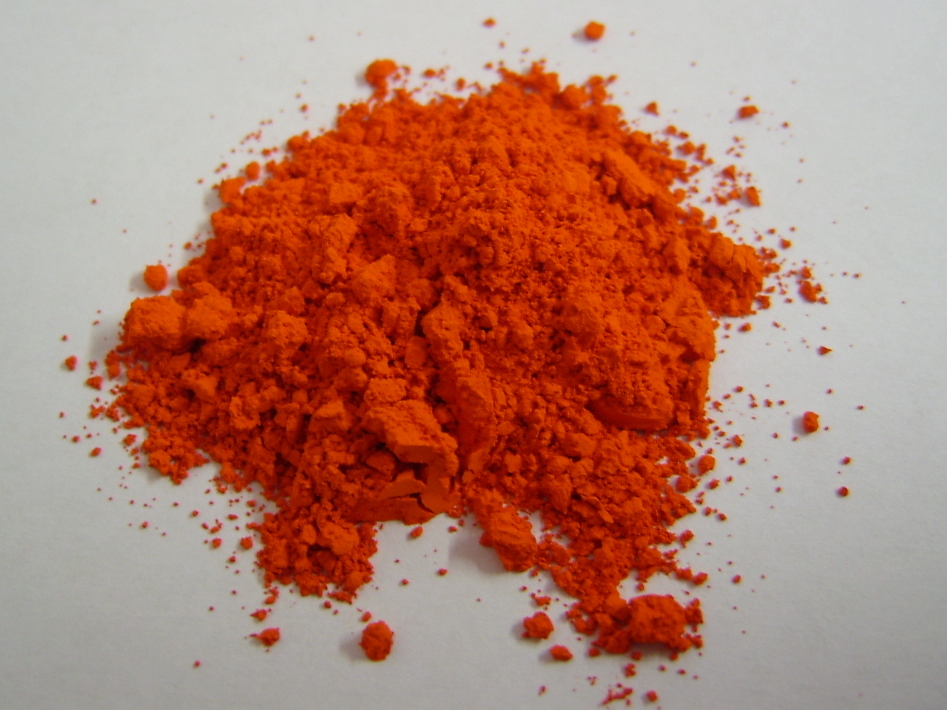
Red lead, Chemical compound. Wikipedia's description, not ours.
The history
The Latin for it is minium, and a manuscript illuminator who worked in minium was a miniator. The pictures they made were miniatura, and that is where 'miniature' comes from. The word has nothing to do with smallness originally; it means made with red lead. The small-picture meaning came later by association and then swallowed the original.
It is the orange-red in nearly every early medieval manuscript, in Byzantine and Persian and Indian painting, and in Chinese work. It also has a serious defect: it can blacken, converting to plattnerite or reacting with sulfur compounds, and it can also fade to white. Manuscripts with mysteriously dark or blank patches often have this pigment in them.
Its industrial life was much longer than its artistic one. Red lead primer was the standard anti-corrosive paint for structural steel (bridges, ships, railings) for well over a century, because it genuinely stops rust better than most things invented since. It was phased out through the 1970s and after on lead-toxicity grounds, and the Forth Bridge's famous colour is part of that history.
Where it is used
Manuscript illumination, rubrication, icon painting, and structural steel priming. Traditional Indian sindoor was sometimes red lead rather than vermilion, which was its own health problem.
It is the clearest case of a colour whose name outlived its use and changed meaning entirely. When you brief a 'miniature' you are unknowingly specifying a pigment. Worth remembering that a great deal of design vocabulary (leading, stereotype, cliché, lower case, stet) is the physical residue of a workshop nobody in the room has been in.
Go and look at it
Insular and Carolingian manuscripts
British Library, London; Trinity College, Dublin
The orange-red in initials and rubrics. Where the word miniature comes from.
The Forth Bridge
Firth of Forth, Scotland
Red lead primer, repainted continuously for a century. 'Painting the Forth Bridge' is a phrase about this pigment.
How it behaves
- Made of
- Lead tetroxide, Pb₃O₄, made by roasting lead white or lead metal in air.
- Opacity
- Opaque. It covers what is under it.
- Lightfastness
- Moderate. It will move, noticeably, within decades, faster in thin films and tints.
Hazard
A lead compound. Toxic by ingestion and inhalation; withdrawn from most uses on that basis.
- Can blacken or fade to white depending on conditions, which is why medieval manuscripts have odd patches.
- Excellent rust inhibitor, which kept it in industrial use long after it left the studio.
- Accelerates the drying of oil dramatically.
The numbers
All derived from the hex, never typed beside it
- HEX
- #E25822
- What a browser and a design file want.
- RGB
- 226, 88, 34
- The same three numbers in base ten. Light, not ink.
- HSL
- 17°, 77%, 51%
- Hue, saturation, lightness, how a person describes a colour.
- CMYK
- 0, 61, 85, 11
- Arithmetic only. A real separation depends on the press, the paper and a profile.
- LAB
- 55, 51, 56
- Perceptual. L* of 55 is how light this actually looks, which HSL gets wrong.
This hex is an approximation, and a page about pigment has to say so. Red lead is a substance. A ground mineral scatters light from thousands of separate grains at slightly different angles, and no single sRGB value is that event. It is a flat average of a photograph of it, and the real thing is outside what a screen can emit. Use the number to specify a screen colour. Do not use it to judge the pigment.
Where it sits on the wheel
Hue 17°
Its opposite, by the diagram
The arithmetic opposite, 180° round in HSL. Useful, and not the same as the opposite a painter mixing pigment would name, that wheel was built for paint.
Lighter and darker
Towards white
Mixing with white does not only lighten, it dulls and cools. This is why a pale tint of a brand colour so often looks chalky, and why a designed light shade beats a generated one.
Towards black
Mixing with black kills the hue as it darkens. A better dark is usually the colour plus its neighbour round the wheel, which is what every painter does instead.
Can you set type on it
Handgloves
White on it
3.72:1 · Large text only
Handgloves
Black on it
5.65:1 · AA
Handgloves
It on paper
3.53:1 · Large text only
Handgloves
It on ink
4.92:1 · AA
4.5:1 is the floor for body text and 3:1 for large text, by WCAG. Treat it as a minimum you may not go under rather than as a target: plenty of pairs pass at 4.6:1 and are still unpleasant to read for a page, and the checker will not tell you that.
Read more, elsewhere
Colours next to this one
Back up
Foundations · Colour·orange·Made in a lab or a works