The Palette/orange/Ground from a rock or crystal
Realgar
Orpiment's orange twin, equally poisonous, and it slowly disintegrates into orange powder under light.
Also called ruby sulphur · arsenic blende · manashila
- Hex
- #D9381E
- RGB
- 217, 56, 30
- First used
- Antiquity
- From
- Volcanic and hydrothermal deposits: Anatolia, Persia, China, Romania
What it is
Arsenic sulfide, As₄S₄.
How it is made
Mined, sorted and ground, like orpiment, and just as hazardous. The Arabic name rahj al-ġār, 'powder of the mine', gives the English word.
Its instability is a chemistry problem rather than a handling one. Under light realgar converts progressively to pararealgar, which is yellow and powdery, and the conversion breaks the crystal structure up. The paint layer literally falls apart.
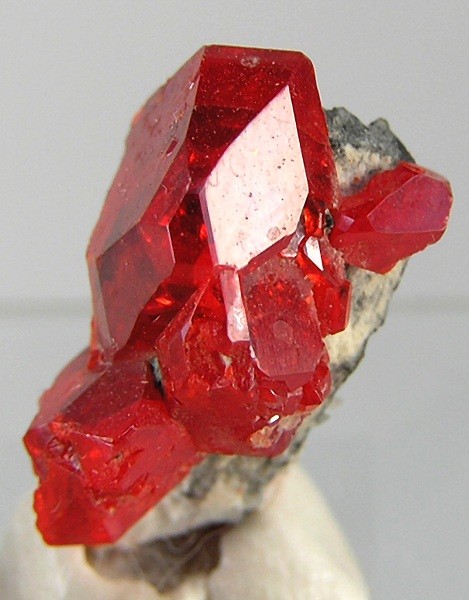
Realgar, Arsenic sulfide mineral. Wikipedia's description, not ours.
The history
Realgar gave a warm orange that nothing else could reach before chrome and cadmium arrived: brighter than red ochre, less cold than vermilion, cheaper than both. It appears in Egyptian, Roman, Persian, Indian, Chinese and European work.
It was also a medicine (a component of traditional Chinese and Ayurvedic preparations) and a component of the fireworks trade, where arsenic sulfides gave a white flame. Occupational arsenic poisoning among the people making it was routine and accepted.
As a conservation subject it is unusually informative: because the degradation product, pararealgar, is a distinct compound with a distinct signature, a conservator can prove that a passage which now reads as dull yellow crumble was once a bright orange. It is one of the clearest cases where analysis recovers a painter's original intention rather than guessing at it.
Where it is used
Painting, manuscripts, fireworks and medicine. Long obsolete in all of them.
The interesting general point is about degradation being legible. Some materials fail in ways that leave a record of what they were, and some fail into anonymity. If you are choosing something now that has to last (a paint, a substrate, a file format) it is worth asking which kind of failure it has, because the first kind can be recovered and the second cannot.
Go and look at it
Passages of crumbling orange in early panel painting
Conservation labs more than galleries
Identified by the pararealgar signature. Proof of an orange that is no longer there.
How it behaves
- Made of
- Arsenic sulfide, As₄S₄.
- Opacity
- Semi-opaque. It covers, but something of the layer beneath still comes through.
- Lightfastness
- Fugitive. It leaves. Work made with it is already less than it was.
Hazard
Arsenic sulfide. Poisonous. The degradation makes loose arsenic-bearing dust, which is worse.
- Converts to yellow pararealgar under light and physically crumbles.
- Blackens lead and copper pigments, exactly like orpiment.
The numbers
All derived from the hex, never typed beside it
- HEX
- #D9381E
- What a browser and a design file want.
- RGB
- 217, 56, 30
- The same three numbers in base ten. Light, not ink.
- HSL
- 8°, 76%, 48%
- Hue, saturation, lightness, how a person describes a colour.
- CMYK
- 0, 74, 86, 15
- Arithmetic only. A real separation depends on the press, the paper and a profile.
- LAB
- 49, 61, 52
- Perceptual. L* of 49 is how light this actually looks, which HSL gets wrong.
This hex is an approximation, and a page about pigment has to say so. Realgar is a substance. A ground mineral scatters light from thousands of separate grains at slightly different angles, and no single sRGB value is that event. It is a flat average of a photograph of it, and the real thing is outside what a screen can emit. Use the number to specify a screen colour. Do not use it to judge the pigment.
Where it sits on the wheel
Hue 8°
Its opposite, by the diagram
The arithmetic opposite, 180° round in HSL. Useful, and not the same as the opposite a painter mixing pigment would name, that wheel was built for paint.
Lighter and darker
Towards white
Mixing with white does not only lighten, it dulls and cools. This is why a pale tint of a brand colour so often looks chalky, and why a designed light shade beats a generated one.
Towards black
Mixing with black kills the hue as it darkens. A better dark is usually the colour plus its neighbour round the wheel, which is what every painter does instead.
Can you set type on it
Handgloves
White on it
4.63:1 · AA
Handgloves
Black on it
4.53:1 · AA
Handgloves
It on paper
4.40:1 · Large text only
Handgloves
It on ink
3.95:1 · Large text only
4.5:1 is the floor for body text and 3:1 for large text, by WCAG. Treat it as a minimum you may not go under rather than as a target: plenty of pairs pass at 4.6:1 and are still unpleasant to read for a page, and the checker will not tell you that.
Read more, elsewhere
Colours next to this one
Back up
Foundations · Colour·orange·Ground from a rock or crystal