The Palette/blue/Made in a lab or a works
Maya blue
A plant dye locked inside a clay so it cannot fade, the only ancient blue that survives being buried in a tropical jungle.
Also called azul maya
- Hex
- #73C2FB
- RGB
- 115, 194, 251
- First used
- c.800 AD
- From
- Yucatán and the wider Maya region
What it is
Indigo dye bonded into palygorskite, a fibrous clay with channels in its structure. Not a mixture: the dye sits inside the mineral.
How it is made
Indigo from the leaves of añil is combined with palygorskite clay and heated gently. Around 150°C seems to do it. The dye molecules move into the clay's microscopic channels and are held there mechanically as well as chemically.
Nobody is completely certain of the original procedure. One well-supported reconstruction involves copal incense as the heat source, which would mean the pigment was made during a ritual rather than in a workshop, the colour and the ceremony being the same event. That reading is argued about and should be held as a strong hypothesis, not a settled fact.
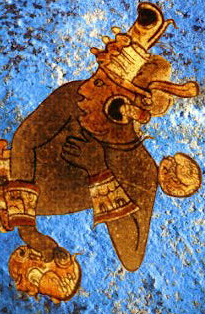
Maya blue, Azure blue pigment made in pre-Columbian Mesoamerica. Wikipedia's description, not ours.
The history
Organic dyes do not last. Put indigo on a wall in Yucatán and the sun, the rain and the fungus will have it within a few decades. Maya blue has sat on exposed murals for over a thousand years in one of the harshest climates for pigment on earth and is still blue, which is why it took chemists until the 1960s to work out what it even was.
It is found on murals, on pottery, on sculpture, and on the bodies of sacrificial victims and objects thrown into the cenote at Chichén Itzá, where a thick layer of blue silt at the bottom is the accumulated residue of centuries of offerings. The colour was associated with Chaak, the rain deity, which links it to water and to sacrifice.
It is the best argument in the whole history of colour for engineering over material. The Maya did not have a better blue than anybody else. They had an ordinary plant dye and a way of housing it that made it permanent, which is a materials-science result a thousand years early.
Where it is used
Murals at Bonampak and Cacaxtla, painted pottery, stucco, codices, and ritual objects. Modern conservation science studies it as a model for stabilising organic colourants, which is an unusual afterlife for a pigment.
If there is a transferable idea here it is this: durability is usually a structural problem rather than a materials problem. The question to ask of a fragile thing is not 'what stronger thing can replace it' but 'what can I put it inside'.
Go and look at it
The Bonampak murals
Chiapas, Mexico, in situ
Blue still reading as blue on an exposed wall after more than a millennium. No European pigment of the period would have survived it.
The Sacred Cenote at Chichén Itzá
Yucatán, Mexico
A layer of blue sediment metres thick at the bottom. The pigment was thrown in, not painted on.
How it behaves
- Made of
- Indigo dye bonded into palygorskite, a fibrous clay with channels in its structure. Not a mixture: the dye sits inside the mineral.
- Opacity
- Semi-opaque. It covers, but something of the layer beneath still comes through.
- Lightfastness
- Permanent. It will outlive the thing it is painted on.
- Resists acid, alkali, solvents and biological attack, extraordinary for anything built on a plant dye.
- The colour varies from a pale sky to a deep greenish blue depending on the indigo load.
The numbers
All derived from the hex, never typed beside it
- HEX
- #73C2FB
- What a browser and a design file want.
- RGB
- 115, 194, 251
- The same three numbers in base ten. Light, not ink.
- HSL
- 205°, 94%, 72%
- Hue, saturation, lightness, how a person describes a colour.
- CMYK
- 54, 23, 0, 2
- Arithmetic only. A real separation depends on the press, the paper and a profile.
- LAB
- 76, -9, -36
- Perceptual. L* of 76 is how light this actually looks, which HSL gets wrong.
This hex is an approximation, and a page about pigment has to say so. Maya blue is a substance. A ground mineral scatters light from thousands of separate grains at slightly different angles, and no single sRGB value is that event. It is a flat average of a photograph of it, and the real thing is outside what a screen can emit. Use the number to specify a screen colour. Do not use it to judge the pigment.
Where it sits on the wheel
Hue 205°
Its opposite, by the diagram
The arithmetic opposite, 180° round in HSL. Useful, and not the same as the opposite a painter mixing pigment would name, that wheel was built for paint.
Lighter and darker
Towards white
Mixing with white does not only lighten, it dulls and cools. This is why a pale tint of a brand colour so often looks chalky, and why a designed light shade beats a generated one.
Towards black
Mixing with black kills the hue as it darkens. A better dark is usually the colour plus its neighbour round the wheel, which is what every painter does instead.
Can you set type on it
Handgloves
White on it
1.94:1 · Fails
Handgloves
Black on it
10.84:1 · AAA
Handgloves
It on paper
1.84:1 · Fails
Handgloves
It on ink
9.44:1 · AAA
4.5:1 is the floor for body text and 3:1 for large text, by WCAG. Treat it as a minimum you may not go under rather than as a target: plenty of pairs pass at 4.6:1 and are still unpleasant to read for a page, and the checker will not tell you that.
Read more, elsewhere
Colours next to this one
Next, in time
Sap green
Boiled buckthorn berries, stored in a pig's bladder, and gone within a generation of being painted.
Back up
Foundations · Colour·blue·Made in a lab or a works