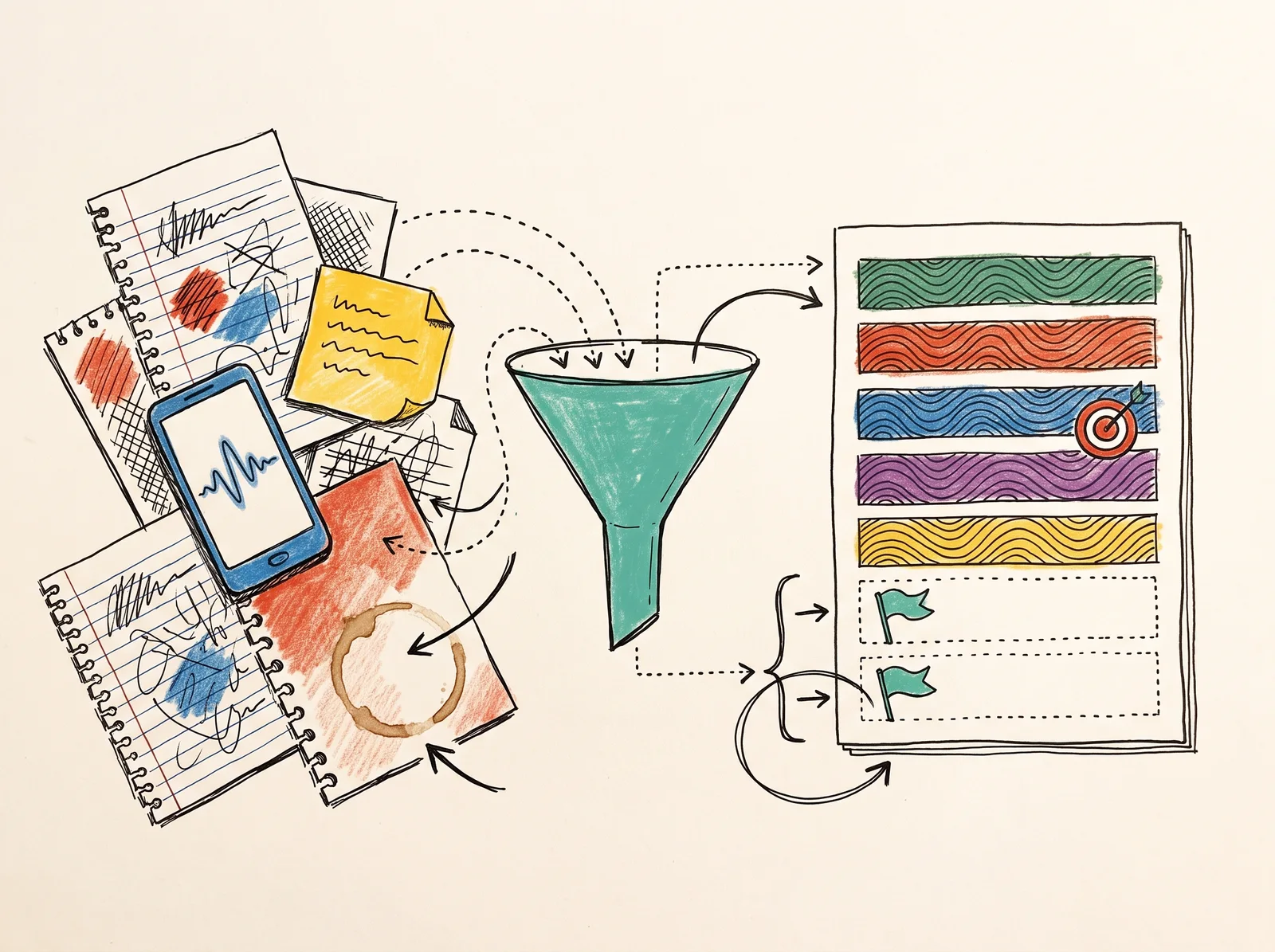
This prompt takes the notes you already have, from a client call, a voice memo or a page of scribbles, and turns them into a one-page creative brief. It comes back in the order a team works from: the problem, the objective, the audience, one , , , deliverables and limits. Anything your notes leave out is marked TO CONFIRM and returned as a question, so the gaps show instead of being filled with guesses.
Use it at the start of a job, before anyone draws a route or books a photographer, or when a client sends a long email that is really a brief in disguise. You need the brand name, the market and your notes, pasted as they are. Once you have answered its questions, the second prompt rewrites the brief with your answers and lists what changed.
The prompts
01The promptText You are a senior strategist at a creative agency. Turn my rough notes into a one-page creative brief that a designer, a copywriter and a photographer could all work from without calling me. Brand: [BRAND]What it sells: [PRODUCT OR SERVICE]Market (country, city or region): [MARKET]My notes, pasted as they are:[YOUR ROUGH NOTES] Rules:1. Use only what my notes say. Where they do not answer something, write TO CONFIRM in that field and add the question to the list at the end. Never invent a fact, number, price, date, claim, result or customer quote.2. The single-minded proposition is one sentence with one idea in it, saying what the audience gets or should come to believe, not only what the product is. If my notes point at several ideas, choose the strongest, say why in one line, and list the others under Left out.3. Keep the argument and the requirements apart: problem, objective, audience and proposition at the top; mandatories, deliverables and limits at the bottom.4. Plain words. No marketing adjectives (premium, innovative, world-class) unless my notes give evidence for them.5. One page: about 350 words for the brief itself. Use these headings, in this order:The problem: the business problem in one or two sentences.Objective: what should change, and how we will know. Use a number only if my notes give one.Audience: one person, described. What they do now, and what they believe that this work has to change.Single-minded proposition: one sentence.Reasons to believe: up to three facts from my notes that make the proposition true. Mark any that needs proof (a test, a certificate, a source) with NEEDS EVIDENCE.Tone: three or four words, each followed by what it rules out.Mandatories: what must appear (logo, legal lines, prices, offer terms).Deliverables: every format and size, with where each one runs.Limits: budget, deadline, and who approves the work.How it will be judged: the two or three tests the work must pass.Left out: ideas from my notes that did not become the proposition, one line each.Questions: every TO CONFIRM as a question I can answer in one line, most important first. If my notes are too thin to find a proposition at all, do not write the brief. Ask me the five questions you most need answered, and stop.Paste into a new chat in Claude, ChatGPT or Gemini, with your own notes in place of the capitals.
02When you have the answersText Here are my answers to your questions:[YOUR ANSWERS] Rewrite the brief with them, keeping the same headings. Remove each TO CONFIRM that is now answered and keep the rest. Under the brief, list what changed in one line each. If an answer changes the single-minded proposition, say so first and explain why.Send in the same chat, so it still has the first brief and your notes.
Checklist
Check the brief before you send it on
- Read it against your notes, line by line, and strike anything you did not say.The commonest failure is a plausible number or claim the model supplied to fill a gap. It reads as fact by the time it reaches a headline.
- The proposition is one sentence with one idea in it.An 'and' in the middle usually means two ideas. Each gets half the attention and neither lands.
- Every NEEDS EVIDENCE line has its proof found, or comes out.A reason to believe in the brief becomes a claim in the copy, and a claim has to be proved.
- The audience is a person with a belief, not an age band.Women aged 25 to 40 in metros gives a writer nothing. A person who thinks hand-printed cotton fades after five washes gives them an argument to win.
- Someone is named as the approver.Most jobs go wrong at approval, when a person nobody briefed arrives with a view.
- Each deliverable says where it runs, and you have counted them.The count decides the shoot and the budget. Finding the Reels after the shoot is the expensive way round.
- Every TO CONFIRM is answered, or left open on purpose.An open question in a brief is fine. One nobody noticed turns up at the presentation.
What to do it with
- ClaudeFree tier, paid above it
A language model that writes, edits, reads long documents and runs tools, including agents that work inside a codebase.
Bad at It is agreeable by default, so it will improve a bad idea instead of telling you it is bad. Ask it to argue against you and the quality of the answer changes.
- ChatGPTFree tier, paid above it
General assistant with image generation, data analysis and web access in one window.
Bad at Its default voice has become recognisable enough that readers now spot it, which is a brand problem if you ship it unedited.
- GeminiFree tier, paid above it
Google's assistant, with a very long context window and tight links to their other products.
Bad at Behaviour changes between the app, the API and the versions inside other Google products.
The words, in plain language
- Single-minded proposition
- The one thing the work must land. One idea, in one sentence.
- Reasons to believe
- The facts that make the proposition true. Each one has to be provable.
- Mandatories
- What must appear whatever the idea: logo, legal lines, prices, offer terms, sizes.
Why it matters
The model can arrange what you know. It cannot decide what matters. Picking the one proposition and letting the other ideas in your notes go is still your decision, and the brief is only as good as that choice.
- Type
- technique
- Period
- ongoing