A is the client's description of the job. It can be a forty-page tender or three lines in an email, and either way it tells you what the client has asked for, which is not always what they need. Reading a brief properly means finding the gap between the two and agreeing it in writing before anybody quotes a fee or opens a file. It is design work. Everything that follows on the project, including the research, the criteria the work is judged against, the price and the timeline, is set up by how well this part is done.
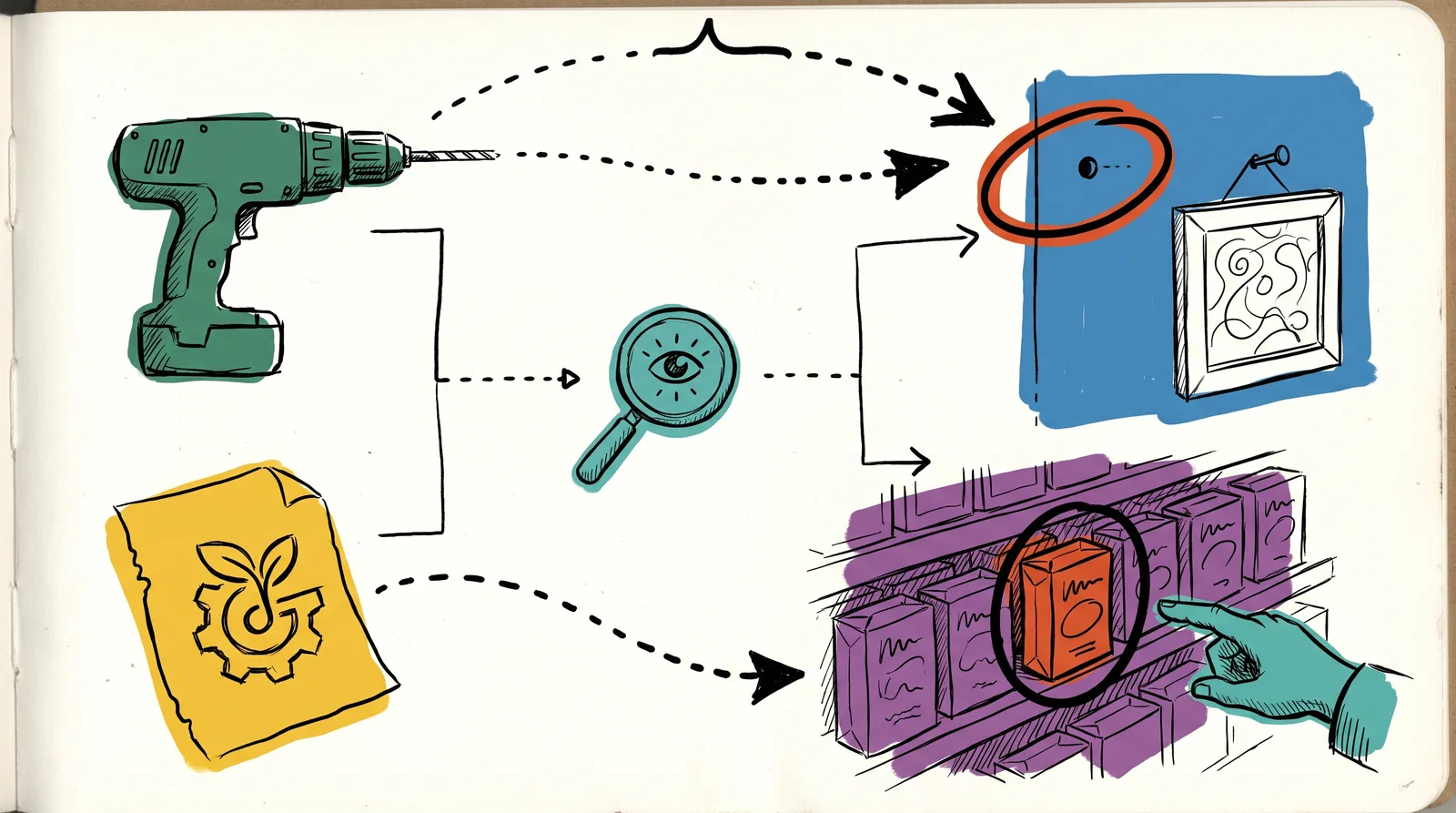
Clients arrive with a solution rather than a problem. We need a new logo, we need a website, we need a rebrand. Sometimes that is right. Frequently it is a guess at the remedy for something they have described to themselves in the only vocabulary they have. Salespeople have known this for a long time. The line that nobody wants a quarter-inch drill, they want a quarter-inch hole, is usually credited to Theodore Levitt of Harvard Business School, who credited it himself to a New York newspaper man, Leo McGivena, and Quote Investigator has found it in an insurance advertisement from 1942. A logo is often the drill. The hole might be a sales team embarrassed by its pitch deck, or a product nobody can find on a shelf.
Interrogating a brief does not mean disputing it. It means finding out what changed recently, what has been tried, and what would have to be true for the project to have been worth doing. Toyota built a blunt tool for this kind of digging into its factories. The five whys, devised by Sakichi Toyoda and called by Taiichi Ohno the basis of Toyota's scientific approach, asks why a problem happened, then why that happened, and keeps going until it reaches a cause somebody can fix. Critics point out that the fifth why is arbitrary and that two people asking can reach different causes. On a design brief it still works. Two or three rounds usually get you from the logo to the thing the logo was meant to fix.
Read every brief for five things, and mark each one as found, missing or vague. The first is the problem, stated as a situation in the business rather than as a deliverable. The second is the audience, described closely enough that you could go and find one of them. The third is the , meaning the budget, the deadline, legal copy and anything that already exists and has to survive. The fourth is success, in terms somebody could check six months after launch. The fifth is who decides. Most briefs are detailed about the deliverable and thin on the last two, and those are exactly the two that decide whether a project ends well.
Designers have a formal name for this stage. The Design Council's Double Diamond splits a project into discover, define, develop and deliver, and says the first diamond helps people understand, rather than simply assume, what the problem is. On a studio project the practical result of that first stage is a . You write the brief back to the client in your own words, with the problem, the audience, the constraints, the measure of success and the name of the person who signs off, and ask them to confirm it or correct it. Clients often correct it. That correction is the most useful conversation of the whole project, because it happens before a single idea exists to argue about.
Here is how it goes on a typical job. A family bakery asks for a new logo because the old one looks dated. Ask what happens if nothing is done, and the owner says sales to cafés have fallen for two years. Ask who is unhappy, and it is the son who now runs wholesale, whose buyers cannot tell the bakery's loaves from the supermarket's once the bread is on a café counter. Ask what has been tried, and there was a new website last year that changed nothing. The brief still involves a logo. The job is now about recognising bread out of its bag, which might mean a label, a paper band or a mark baked into the crust, and success has a measure, the bakery's name on the menus of the cafés that stock it. A shoot brief bends the same way. Had the bakery asked for new photographs instead, the same questions would have led to pictures a café could put on its menu, which changes the shot list before anybody books a photographer.
Checklist
Eight questions to answer before you quote
- What happens if nothing is done?It separates a business problem from a preference. A project with no answer here is the first to be cut.
- What changed recently?Projects start because something moved, such as a new competitor, a new chief executive or a fall in sales.
- What has been tried already, and what happened?It stops you proposing last year's failure, and it shows you what the client believes is causing the problem.
- Who is unhappy, and who signs the work off?They are often different people. The one who signs off has to be in the room when you present.
- Who exactly is the work for?Everyone is not an audience. You should be able to describe one real customer.
- What must not change?Recognised assets, legal copy and stock that is already printed all limit the design. Find them before you draw anything.
- What is the budget, and which date cannot move?A launch, a trade fair or a factory slot usually sets the calendar, and nobody in the meeting controls it.
- How will we know in six months that it worked?The answer becomes the success criterion in your proposal, so the work is judged against it rather than against taste.
The words, in plain language
- Brief
- The client's description of the job. Anything from a forty-page tender to three lines in an email.
- Presenting problem
- What the client says they need. Often a symptom.
- Underlying problem
- What is actually wrong. Usually found by asking why three times.
- Success criterion
- How anybody will know the work worked.
- Constraint
- A fixed limit the work has to respect, such as the budget, the deadline or legal copy.
- Reverse brief
- The brief written back to the client in your own words, for them to confirm or correct.
- Sign-off
- The person whose approval ends a stage. Name them before the work starts.
Why it matters
Ask what happens if nothing is done. The answer separates a real business problem from a preference. If the honest answer is that things continue roughly as they are, the project has no urgency behind it and will be the first thing cut when budgets tighten, which is worth knowing before you quote, book people or turn down other work. A project pushed by a launch date or a falling number tends to survive.
Find out who is unhappy. Most rebrands begin because somebody specific is dissatisfied, and knowing whether that is the founder, the sales team or the board tells you what the work has to achieve and who has to approve it. A project briefed by a marketing manager to please a chairman nobody has mentioned will fail at the final presentation. Ask early who signs the work off, and ask again if the answer is a committee.
Write the success criteria into the proposal, as outcomes rather than deliverables. If nobody can say what better looks like, the work will be judged on taste, and taste is the one criterion where the person paying always wins the argument. Most mistakes come from skipping this stage. Quoting from the brief as written prices the wrong job. Answering it literally produces a good logo for a problem that was never about the logo. Letting the brief grow in conversation without writing the changes down turns a fixed fee into unpaid work by the third meeting.
The module follows a job in order. It covers discovery and research, which test what the brief claims against what customers actually say, and the moodboards and territories that turn a direction into something a client can choose between. It moves on to presenting work, handling feedback and clients whose taste differs from yours, then to the business side, with pricing and scoping, contracts and who owns the work, and timelines and phasing. It closes with writing case studies for a portfolio and with building a studio that lasts, and every one of those depends on the brief agreed here.
Elsewhere
- Type
- term
- Period
- ongoing