An advertisement is one piece of work that has to succeed once. A is a set of pieces connected by one , running across channels and over months or years, where each piece makes sense alone and works harder next to the others. The difference is structural. A campaign needs an idea with room in it, so that the twentieth piece can be as strong as the first, and a layout that can only be copied does not have that room. The test is whether somebody who was not there could make the next correctly. If the idea is written down well enough for that, it is a campaign. If it only exists as a finished poster, you have an advertisement and a hope.
Apple's 1984 is a great advertisement and a useful example of what a campaign is not. It was conceived at the agency Chiat/Day and directed by Ridley Scott, and it had its only US national airing during the third quarter of the Super Bowl on 22 January 1984, after one earlier broadcast in Twin Falls, Idaho, on the last day of 1983. It was never broadcast again. The film launched the Macintosh and became a legend, and nothing followed it in the same form, because the idea was a single event. That is a legitimate choice. A launch, a stunt or an anniversary can be a on purpose, as long as everybody knows that the next piece of work will need a new idea and a new budget.
Now set it against The Economist. In 1988 the agency Abbott Mead Vickers BBDO ran a poster of white type on the magazine's own red, quoting a management trainee, aged 42, who says “I never read The Economist.” David Abbott wrote it, Ron Brown art directed it, and the V&A keeps a copy in its collection. The device was the red of the masthead turned into a poster and filled with one dry line about the kind of person who reads the magazine. Any good writer who understood the tone could write the next one. The agency went on writing them in the same red for years. Each poster was an execution, and the idea underneath was the club you joined by reading.
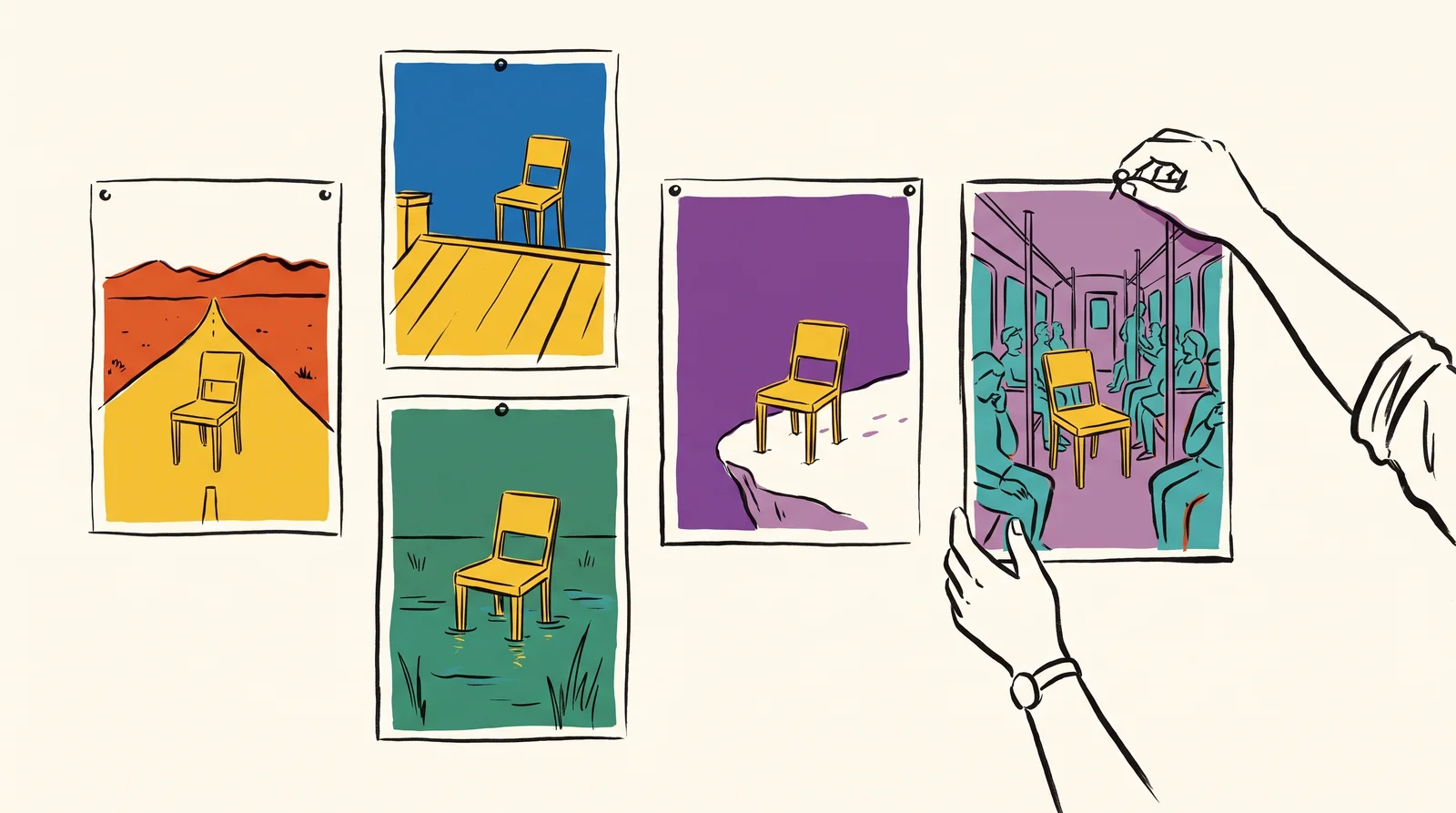
Room comes from a . That means a situation or device that produces new work each time it meets something new. Snickers has run on one since 2010, when BBDO New York launched “You're not you when you're hungry” with a Super Bowl spot in which Betty White and Abe Vigoda play American football. Hunger turns a person into somebody else until a bite brings them back. That one situation has been recast with local celebrities in Latin America, Japan, the Middle East and the UK, and each market gets an ad that feels made for it while the idea stays the same. In 2020 USA Today's Ad Meter named it the best Super Bowl campaign of the previous 25 years.
Apple found a different engine in 2015. Shot on iPhone, made with TBWA\Media Arts Lab and launched in early March that year, put photographs taken by iPhone 6 owners on billboards and in print around the world. Its mechanism is that every good picture a customer takes is a possible execution, so the campaign cannot run out of material, and each new phone gives it a reason to come back. It won the Outdoor Lions Grand Prix at Cannes in 2015. Ten years later, in 2025, the same idea won TBWA\Media Arts Lab a Grand Prix for Creative Effectiveness, which is an award for results over time that a single advertisement could never collect.
Inside every campaign sit three layers, and people confuse them constantly. The idea is the thing that repeats. The line (You're not you when you're hungry) and the look (white type on red) are what the audience actually sees, and both come out of the idea rather than standing in for it. Under those sit the executions, the individual films, posters, posts and emails, each made for its channel. A creative director checks the layers in that order. A strong look with no idea underneath runs out after four pieces, while a strong idea with a weak line can still be rescued by rewriting the line, so the order of work follows the order of importance.
A real case
Absolut, one bottle and over 1,500 ads
Absolut Vodka and the agency TBWA · 1981
What they did
Absolut hired the New York agency TBWA in 1980. The first ad of the campaign, introduced in 1981, showed the bottle under a spotlight with a halo over its cap and two words underneath, Absolut Perfection.
What happened
The formula held for about twenty-five years. Every ad was the bottle, or its shape hidden in something else, under a headline of Absolut and one more word, such as Absolut New York or Absolut Warhol. By the time the campaign ended in 2006 it had produced over 1,500 print ads.
What to take from it
Two fixed parts and one open slot made the next ad easy to brief. Any writer, artist or city could fill the slot while the bottle stayed the hero, and every new ad made the shape more famous.
What to do it with
- ClaudeFree tier, paid above it
A language model that writes, edits, reads long documents and runs tools, including agents that work inside a codebase.
Bad at It is agreeable by default, so it will improve a bad idea instead of telling you it is bad. Ask it to argue against you and the quality of the answer changes.
- FigJamFree tier, paid above it
A whiteboard next to the design files, for workshops, maps and the argument before the work.
Bad at A workshop board is a record of a conversation, not a decision. Somebody still has to write the decision down.
- PitchFree tier, paid above it
Presentation software with real typographic control and shared templates.
Bad at Another tool the client cannot open. Export discipline matters.
The words, in plain language
- Campaign
- A set of work connected by one idea, running across channels and time.
- Idea
- The thing repeated. Not the line, not the look, though it produces both.
- Mechanism
- The repeatable situation or device that turns the idea into a new piece each time it is used.
- Executions
- The individual pieces. Each should make sense alone and better together.
- One-off
- A single piece with nothing behind it. Frequently mistaken for a campaign.
- Platform
- An idea built to last for years, with new campaigns made inside it.
Why it matters
Most campaigns fail by running out. The idea supported four executions and the brief asked for forty, so the last thirty-six are variations of variations, and the audience sees the fatigue before the client does. Ideas with room are ideas with a mechanism. A structure like the same situation in different places, or a repeated device applied to new subjects, generates new work instead of repeating old work, and generation is what a campaign needs for eighteen months.
The commonest mistake is treating a look as an idea. A palette, a typeface and a photographic style make work recognisable, which matters, but they give the next writer nothing to write about, so every execution has to be invented from scratch and sold to the client again. Each new invention costs another round of concepts and approvals, and often a new shoot. The second mistake is briefing each channel separately, so the film and the social posts are made by different teams from different briefs. They look related and say different things. The audience meets them in no particular order and never adds them up.
Write the idea in one sentence and test it against the twentieth execution before committing. If you cannot imagine that one, the idea is a layout. The opposite error is real too. Teams bored of their own campaign often kill it long before the audience has noticed it, and a new idea costs far more than new executions of a working one. Absolut kept one formula for about twenty-five years, and the judgement a creative director is paid for is telling fatigue in the meeting room from fatigue in the market.
The module takes a campaign apart. It starts with testing an idea at the smallest format it will run in, then writing the line that carries it. It covers what each channel can carry, and how to adapt work for a new shape without watering it down. After that comes the practical side, with the asset matrix that counts every file a campaign owes, the order in which a launch unfolds, and how to measure the result honestly. It ends with campaigns that ran too long, and with running a campaign whose variants are generated from one approved master.
Elsewhere
- Type
- term
- Period
- ongoing