An decides what a piece of work should look like, and then makes sure that the finished thing, after it has passed through a dozen other people's hands, still looks that way. The job breaks into four verbs. Decide what the work should look like. the people who will make it. Watch it being made, and correct it while correcting is still cheap. Then take responsibility for the result, which means approving it, defending it to the client and answering for it if it fails. Nearly everything else that gets called art direction is one of those four with a longer name. Learn them as four separate skills, because most people are naturally good at one or two and weak at the rest.
The title covers several jobs, so it helps to know which one you are reading about. In advertising, an art director is one half of a creative team, paired with a who writes the words, and the two develop the idea together under a . The pairing is usually credited to Bill Bernbach of the New York agency Doyle Dane Bernbach. On a magazine, the art director decides how the covers, pages and photographs look, issue after issue. In film, the art director runs the art department and works directly below the . That second title was invented for Gone with the Wind, because its producer David O. Selznick felt that art director did not describe how much of the film's look William Cameron Menzies controlled. The four verbs hold in all three. What changes is the size of the team you direct.
Art direction is also a different job from design, although one person often does both, and the next lesson, "The difference between art direction and design", draws the line between them. The short version is that a makes the thing and an art director decides what thing should be made, and whether the one on the screen is it. Most art directors start as designers and grow into the role by being trusted with small decisions and getting them right.
The most famous piece of art direction in advertising shows the first verb at work. In 1959 Doyle Dane Bernbach began advertising the Volkswagen Beetle in the United States, where it was a small, strange-looking car from a factory the Nazis had built in Wolfsburg, offered to a country buying big cars for growing families. Car advertisements of the time crammed in as much information as they could, and full-colour pages were common. Helmut Krone, the art director, worked on it with the copywriter Julian Koenig. They went the other way. Krone put a small black-and-white photograph of the car in the top left of a page that was mostly empty, with a two-word headline below it, Think small, set in a sans-serif type and ending in a full stop. Every choice on that page was made against the category, and each one turned the car's size into a reason to buy it. In 1999 Advertising Age named it the best advertising campaign of the twentieth century.
The other verbs show in what happened next. Krone art directed the first hundred ads of the campaign while several writers followed Koenig, and although the layout shifted over the years, its essential elements were kept the same, which gave the campaign a house style. Holding a look steady across a hundred ads is watching, done one ad at a time. Choosing people is part of it too. At Vogue in the early 1940s the art director Alexander Liberman took on a young designer, Irving Penn, as an associate in the art department and set him to work on layouts, then asked him to try photography. Penn's first photographic cover for Vogue ran in October 1943, and he went on photographing for the magazine for the rest of his career. What Liberman did there was see what Penn could do and give him the work, and an art director makes that same call on every job that needs a photographer, a stylist or an illustrator.
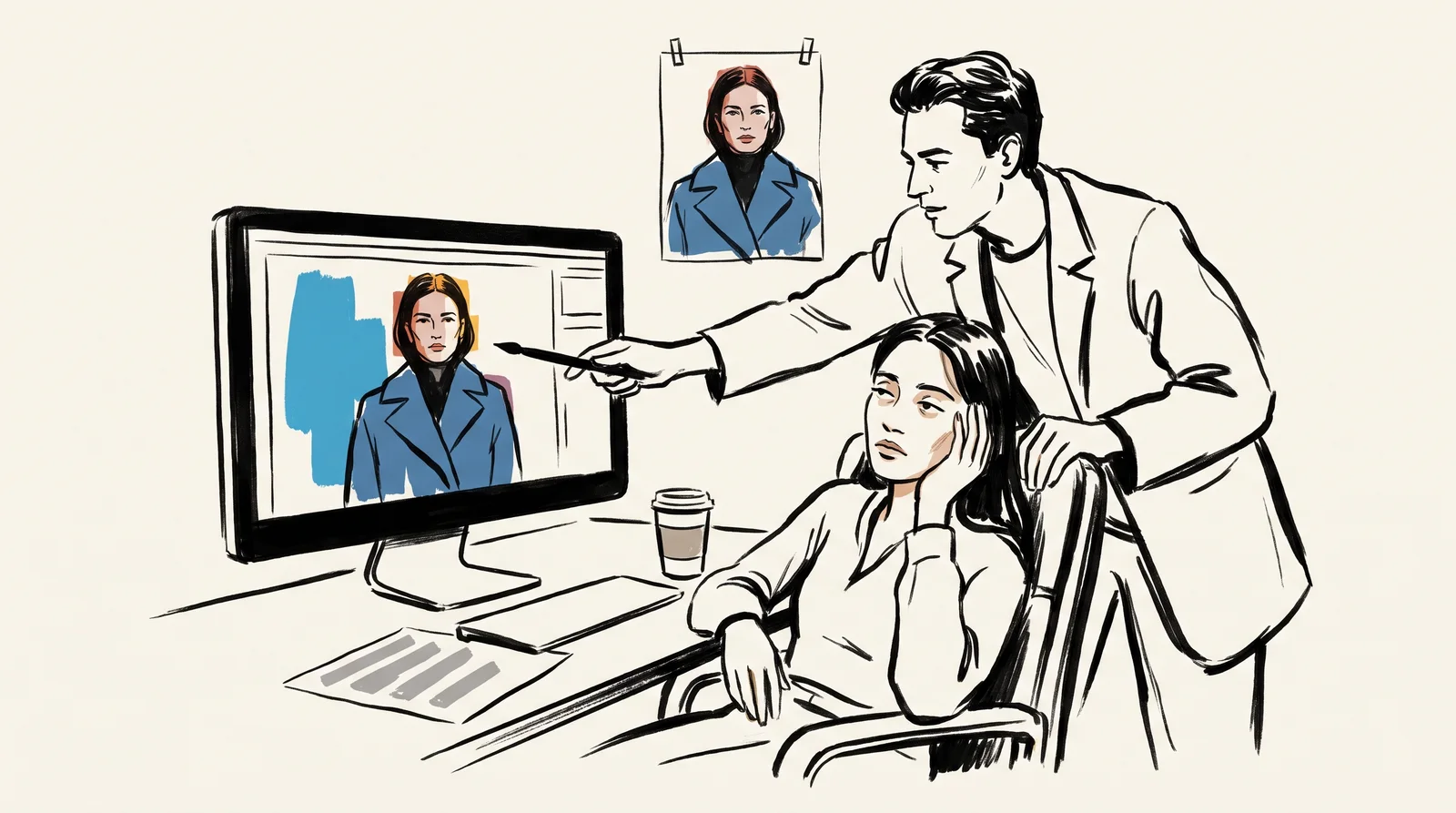
On an ordinary job the four verbs look like this. Say a small tea company wants photographs of a new green tea for its website and its social posts. Deciding means writing one sentence, such as the ten quiet minutes before the house wakes up, and working out what follows from it, which here means low early light from one side, one cup, a kitchen that looks lived in, and no face. Briefing splits it into instructions. The photographer gets the light and the frame shapes, the stylist gets the cup, the cloth and the hands, and the set designer gets the table and the wall. Watching happens at the tethered screen, the monitor the camera feeds straight into. If the steam vanishes against a pale wall, you ask for the cup to move in front of the dark doorway, and the frame is fixed in ninety seconds. Responsibility comes at the end, when you choose the frames, write down why each one is right, and present them to the client as your choice.
Try this
Art direct one photograph without touching the camera
Choose something ordinary to photograph, such as a mug of coffee on a kitchen table or a pair of shoes by a front door. Write one sentence saying what the picture should make somebody feel or believe. Turn it into a brief of five lines at most, covering the light, the camera height, the frame shape, what is in the frame and what is left out. Hand the brief and a phone to a friend. Do not touch the camera yourself. Watch the screen while they shoot and give three notes, each one a physical change they can make in under two minutes, and write every note down before you say it so you can read the list back afterwards. Then choose one frame and write two sentences on why it is the right one.
Time: About an hour. You need: A phone camera, a friend willing to take instructions, Paper and a pen.
Look for
- Whether your one sentence ruled anything out. If every frame could fit it, it was too loose.
- Where your friend had to guess. Every guess marks a line missing from the brief.
- Whether each note named a physical change, such as the camera, the light or the crop, instead of a feeling.
- How far the first frames drifted from the picture in your head, and which note brought them back.
- Whether your two sentences of sign-off would convince somebody who was not in the room.
What to do it with
- Are.naFree tier, paid above it
Collecting and connecting references in channels, with no feed and no algorithm.
Bad at Deliberately slow and unsocial. That is the point and it is also why teams abandon it.
- FigJamFree tier, paid above it
A whiteboard next to the design files, for workshops, maps and the argument before the work.
Bad at A workshop board is a record of a conversation, not a decision. Somebody still has to write the decision down.
- Capture OneSubscription
Raw processing and tethered capture, with colour handling professionals prefer to the alternative.
Bad at Priced for working photographers and organised the way they think. A designer will find the catalogue alien.
- ClaudeFree tier, paid above it
A language model that writes, edits, reads long documents and runs tools, including agents that work inside a codebase.
Bad at It is agreeable by default, so it will improve a bad idea instead of telling you it is bad. Ask it to argue against you and the quality of the answer changes.
The words, in plain language
- Art director
- The person who decides how a piece of work should look, briefs the people who make it, and answers for the result.
- Designer
- The person who makes the thing. Often the same human as the art director, working in a different mode.
- Creative director
- Oversees the ideas and output of a whole team or studio, including the art directors and writers in it.
- Copywriter
- The writer an advertising art director is paired with. The two work on the idea as one team.
- Brief
- The written instruction a specialist works from. It says what the work is for and what it has to achieve.
- Sign-off
- Approving the work and taking responsibility for it. What separates the role from having opinions.
- Production designer
- In film, the head of the art department. The film's art director works directly below them.
Why it matters
The part beginners underestimate is the watching. A brief handed over and collected three weeks later produces work that has drifted, because every person who touched it made small, reasonable decisions with nobody there to say otherwise. On a shoot the drift is expensive. The stylist warms the palette, the photographer adds a fill light that flattens the mood, and each change looks sensible on its own. By the time anybody compares the frames with the brief, the set has been struck and the model is booked elsewhere, and getting the picture back means paying for the day again.
The part they overestimate is having the idea. Ideas are cheap and plentiful. Holding one against a nervous client, a tired crew, a budget cut and four rounds of feedback is the job, and what it takes is stamina and precise language. Precision means saying what you want in terms somebody can act on. A note such as make it feel more premium gives the photographer nothing to do except guess. Raise the camera, take the second light out and let the right side go dark is a note they can carry out in ninety seconds, and every note you give should be that concrete.
The third mistake is approving work you cannot explain. An art director who signs off a frame because the client seemed to like it, and then blames the photographer when the campaign falls flat, has given away the one part of the job that nobody else can do for them. means your name is on it. Before you approve anything, say in one sentence why it is right for this brief, and if the sentence will not come, keep looking.
The module takes each verb in turn. It begins by separating direction from design, then shows how a set of images can make one claim and how to protect that claim through rounds of client feedback. It covers directing specialists who know their craft better than you, holding one look across a whole campaign, working as a pair with a writer, showing a client a look before a single frame exists, and giving a photographer notes they can use on the next frame. Then it moves on set, to the tethered screen and the clock, and ends with reviewing work against written criteria instead of personal preference, and with directing a machine that makes images.
Elsewhere
- Type
- term
- Period
- ongoing