is deciding what the work looks like and then defending that decision against everything easier. An art director sets the idea and the look, briefs the people who make the pictures, chooses from what comes back, and puts their name on the result. For most of the history of commercial image making, the hard part of that chain was the making. was the barrier. Lighting a bottle so glass reads as glass took a decade to learn, and that decade was the moat that kept the number of people who could deliver a finished picture small.
The moat is gone. A competent frame now takes a few minutes, and Google lists a 1K image from its Nano Banana 2 model at under seven cents through the Gemini API. Volume follows price. For its 2025 holiday films, Coca-Cola's own behind-the-scenes video said five specialists made and refined over 70,000 clips in 30 days, a story told in full in the case below. When anyone can make a finished-looking picture that cheaply, a finished-looking picture stops being evidence of skill, and the part of the job that was always hardest to see becomes the part a client cannot get anywhere else.
What has not moved is knowing which frame. That means knowing which of forty is on brand, which one the category has already used to death, and which one will still look right in eighteen months. Those were always the art director's questions, and they were always the part clients underpaid for, because execution was visible and judgement was not. Generation has made the imbalance obvious. When the making costs cents, the deciding is most of what a client is paying for, whether or not the invoice says so.
A model also makes direction harder to skip, in two ways this module returns to. The first is the subject of The , and how to leave it. Left alone, a model produces the average of its training data, and a rival using the same tool gets that same average. The second is that a model never objects, which Art directing a model that cannot be argued with takes apart: a vague word in the brief goes straight into the picture. Ask for premium and modern and you get the average of every image ever captioned with those words.
So the job moves to the places where a person still has to touch the work. The closing lesson, Where a human hand still has to touch it, names all four: the brief, the , the finishing and the approval. Each one is a judgement. Judgement is the part of the work that generation did not make cheap, so it is where an art director's hours now go.
A professional also holds a look, which Building a look and holding it defines as a handful of decisions repeated across everything. The difference shows in a single brief. Take a coffee brand's new roast. The unsteered version is a cup on a wooden café table with steam curling off it. The directed version puts the camera at table height a metre away, with hard morning light from the left, a pale plaster ground and the brand's green filling about a tenth of the frame, and it rules out steam and latte art in writing. The second brief takes longer to write and is far quicker to choose from.
How taste is trained, and why it can be taught, is the subject of Taste as a filter, said precisely. For anyone directing generated work, the useful consequence is that taste can be written down, and a studio that writes its down can hand the judging to someone else when the art director is on holiday. In practice that means a short list of what every frame must do and what rules one out, checked against each image before a client sees it.
A real case
Seventy thousand clips, and the same complaint
Coca-Cola, with the AI studios Silverside and Secret Level · 2025
What they did
For the second year running, Coca-Cola's 'Holidays Are Coming' campaign included films generated with AI. Its behind-the-scenes video said five specialists made and refined more than 70,000 video clips in 30 days.
What happened
The comments echoed the poor reception of the 2024 films, with viewers calling the new ones 'immediately forgettable' and 'soulless'. Coca-Cola's head of generative AI said human storytellers had guided the direction, and that the previous year's film had done well with customers.
What to take from it
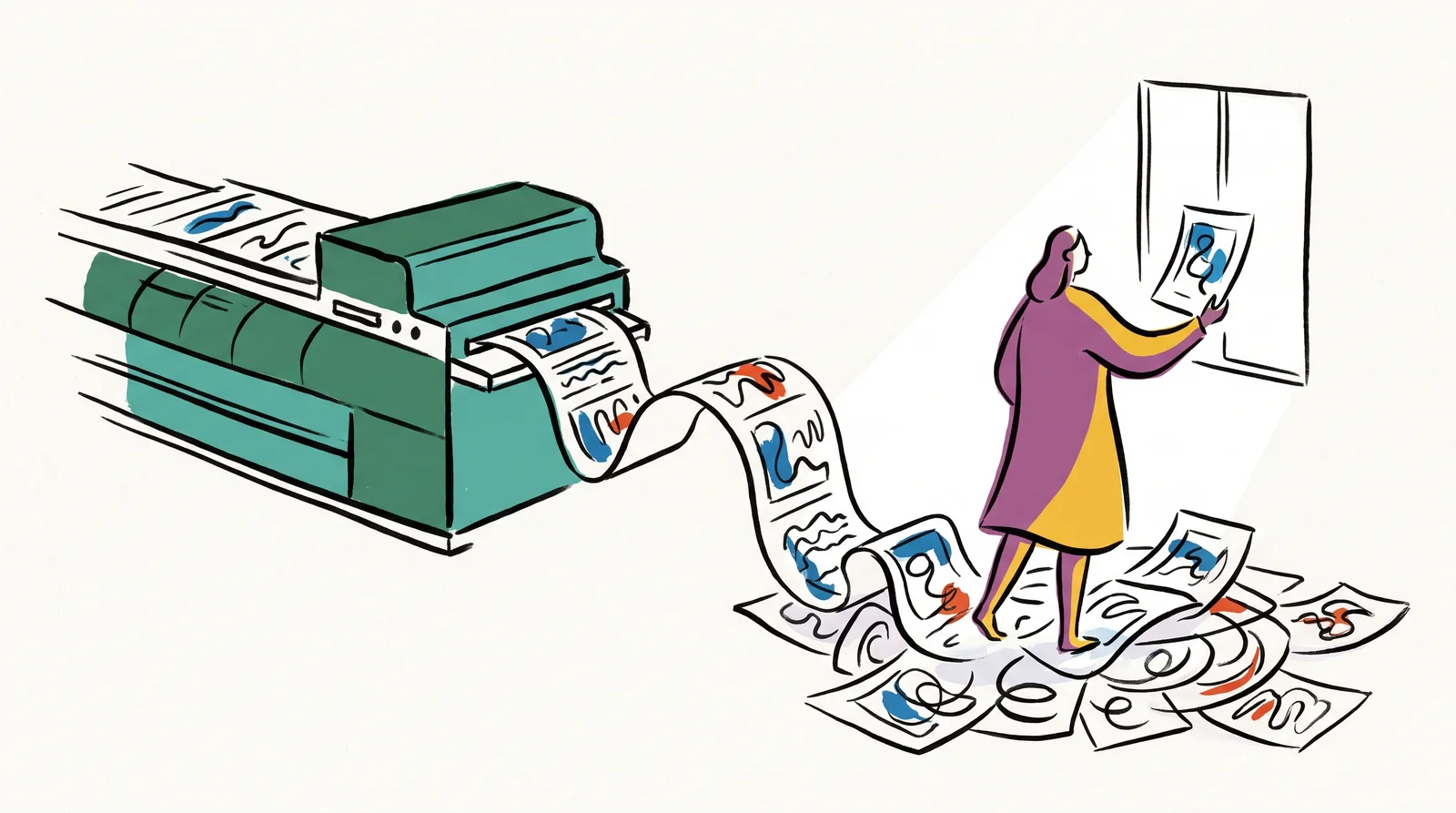
Seventy thousand clips in a month shows how little the making now costs. The argument afterwards was about which frames and what feeling, and no number of clips answers that.
The words, in plain language
- Art direction
- Deciding what the work looks like, and defending that decision against everything easier.
- Execution
- Making it. Historically most of the cost and most of the barrier to entry.
- Commodity
- Something anyone can get at the same price. Generation became one very quickly.
- Authorship
- Whose decisions are in the work. Still a coherent idea, and now the only one that separates studios.
- Generic middle
- Where an unsteered generation lands. Warm, hazy, centred and front-lit, and the same for your competitor.
- Selection
- Choosing the few frames that go forward from everything generated. The new bottleneck.
- Quality bar
- The written standard a frame has to meet before it ships, so judgement does not live in one head.
Why it matters
The commonest mistake is treating volume as progress. Forty options are not a direction. Two hundred generations feel like work, and a studio that sends a client forty variations has usually handed the client the art director's job without saying so, then wonders why the feedback is vague. The Coca-Cola films are the large version of the same mistake. Tens of thousands of clips could not settle which frames and which feeling mattered, and viewers in the comments called the result forgettable and soulless.
The second mistake is letting the model's taste stand in for yours. Output from the generic middle looks competent, so it passes a quick review, and it also looks like everything else in the category, so it does no work for the brand. The habit that guards against it gets its own lesson, Rejecting work, including your own. It matters more now than it did, because a studio that generates makes far more frames than it can use, and the skill is throwing most of them away quickly, its own favourites included.
It changes hiring and pricing as well. The useful junior now is the one who can look at a wall of output and say which four and why, and that skill comes from looking at a great deal of work made before any of this existed. Speed in the software counts for less each year. Selling generations means selling a into a falling market, while selling judgement, a house look and a system that holds it means selling the part that did not get cheap.
The rest of this module turns those ideas into working habits. It starts with a brief precise enough for a model to act on, a method for choosing from a large set of images, and defining a look in a few repeated decisions so it holds across a whole campaign. It then covers spotting the average image a model falls back on and moving away from it, treating taste as something trained, and directing a model that agrees with everything. The last part is about throwing work away, writing the standard down, and the points where a person must step in before anything ships.
Elsewhere
- Type
- term
- Period
- ongoing