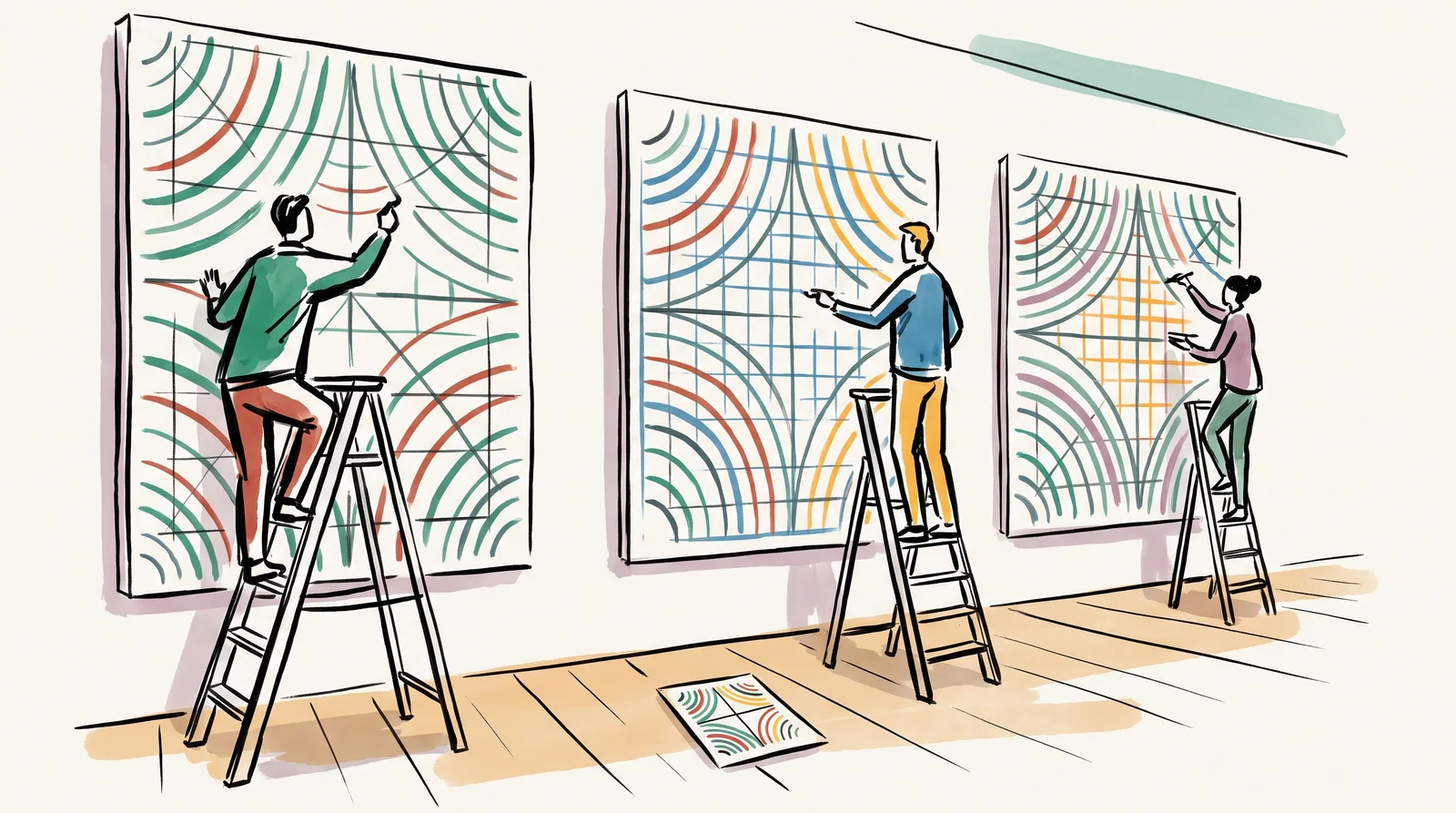
In the deliverable is the , and the artwork is whatever happens when the rule runs. The idea is older than computers. Sol LeWitt wrote instructions for wall drawings and other people drew the walls, and the drawings were his because the instructions were. In 1967, in an essay for Artforum called Paragraphs on Conceptual Art, he wrote that 'the idea becomes a machine that makes the art', and that all the planning and decisions are made beforehand. MASS MoCA in Massachusetts has 105 of his wall drawings on show, made between 1969 and 2007, each one drawn by other people following his written instructions.
Every rule-based system is built from the same few parts, and a beginner needs their names. are the things allowed to vary, such as size, angle, colour, position or number. are the things that may not vary, and they are what makes ten thousand outputs look like one family. A source of variation drives the changes, which might be a random number, a seed that makes the randomness repeatable, a person's name or a live feed of data. Each output is an . A rule for a set of posters might say one circle per sheet, its diameter anywhere between a third and two-thirds of the width, its colour drawn from four brand colours, its centre never within 20 millimetres of an edge, with the headline always set in the same place. Every poster that follows it is correct, and no two need be the same.
Designers were writing rules long before they wrote code. Karl Gerstner, the Swiss graphic designer, published Designing Programmes in 1964, and its best-known line is 'instead of solutions for problems, programmes for solutions'. His argument was that no design problem has one absolute answer, only a group of possible answers, and that the designer's job is to define that group so precisely that choosing the best one becomes an act of selection. Computers made the running cheap. Work that once needed a team of assistants can now produce a thousand instances in a minute, which changes the economics of the method without changing the idea behind it.
Identity work took the method up properly in the 1990s and 2000s, when brands needed marks that could be different every time and still be one thing. The MIT Media Lab's identity, unveiled for its 25th anniversary, is the example most people know. Designed by E Roon Kang and Richard The, it used an algorithm to produce 40,000 versions of one geometric mark, so that each faculty member, staff member and student could claim a shape of their own. In 2014 Pentagram rebuilt the identity on Richard The's seven-by-seven grid, with one fixed ML monogram for the lab and matching glyphs for each of its 23 research groups. Both are rule-based systems. They differ in where they put the part that never changes.
The order of work matters. A working designer makes a few good instances by hand first, because a rule is far easier to write once you know what good looks like. Then they ask which decisions in those instances could become rules and which have to stay fixed, and they write the fixed ones down before anything else. They run it hundreds of times and study the worst outputs, as Where generative systems go wrong explains. Last, they record the seed of anything that has been approved, so that it can be made again exactly when a printer asks for it next year.
This is also the clearest way to understand an image model. A diffusion model is a rule you cannot read, which is the only real difference between it and a system you wrote yourself. Your prompt sets some of the parameters, the model's training supplies the rest, and the seed picks one instance from everything the rule allows. What designers learned about authorship, variation and control in sixty years of rule-based work applies to it directly. The habits carry over too. If you list the before you start, test the worst case as well as the best and keep the seed of every approved image, generated work becomes far easier to keep consistent.
Try this
Write a rule somebody else can draw
Write the instruction for a drawing in no more than three sentences, the way Sol LeWitt wrote his wall drawings: which marks, how many, where, and with what. Give it to two people who do not know what you intended, with the same paper and the same pen, and ask them to follow it exactly without asking you anything. Lay the two drawings side by side.
Time: 30 minutes. You need: Two volunteers, A4 paper and two identical pens.
Look for
- What came out the same in both drawings. That is everything your rule actually fixed.
- What differed, and whether each difference is a freedom you meant to give or a gap in the wording.
- Where either person hesitated or interpreted, because a machine would guess at exactly those points.
- Whether you would sign either drawing. If neither, the rule needs a constraint, not more description.
- How many words the next version needs to make both drawings belong to one family.
The words, in plain language
- Generative design
- Designing the system that makes the artwork, rather than the artwork.
- Rule
- An instruction precise enough that somebody else could execute it identically.
- Parameter
- Something the rule allows to change: a size, an angle, a colour, a count.
- Constraint
- Something the rule holds still. Constraints are what make many outputs read as one family.
- Instance
- One output of the system. There are usually many and they are all correct.
- Invariant
- The part of an identity that never changes, however much the rest varies.
- Emergence
- Behaviour that appears from simple rules without being specified.
Why it matters
It asks a useful question of any brand, which is what must never change. If an identity is allowed to vary, something has to hold still, and finding that thing is a more rigorous exercise than choosing a logo. It might be a grid, a colour, a typeface or a single shape. Everything else can then move. The Media Lab's two identities give two different answers to that question, and a designer who can name the invariant in a system can defend it in a meeting, brief a developer to build it, and explain to a client why instance four hundred still belongs to them.
The common mistakes are predictable. The first, a system with too much freedom and too few limits, is the subject of Parameters, constraints and seeds. The second, judging a system by its best output when the public will meet its worst, is the subject of Where generative systems go wrong. A third belongs to this lesson. It is writing the rule before you have made anything good by hand, which leaves the rule with nothing to aim at, so it produces a family of outputs that nobody wanted.
Be honest about when the technique is wrong. A brand with three touchpoints and no budget does not need a generative identity; it needs one good mark applied consistently. Somebody also has to look after the code, the templates or the written instructions once the project ends, and a system that nobody at the client understands will stop being used correctly within months of the designer leaving. It is not a default, and choosing it should be a decision you can explain in a sentence.
The rest of this module takes the method apart. It starts with the choice of what varies and what does not, and with seeds, then looks at identities that generate themselves and at type, where interpolation between drawn masters has made letterforms generative for decades. After that come pattern and repeat, where the mathematics was settled in the nineteenth century, and real data as the input that gives a system something to be about. The last stretch covers the small amount of code worth learning, print runs where every copy differs, the ways these systems fail, and who the author is when a rule made the artwork. No programming background is assumed. In the campaign project the module feeds two steps. Your style sheet is a constraint list under another name, with the never list doing most of the work, and in Make and choose you keep the seed of every picture you approve, where your tool shows one, and judge the set by its weakest frame. The rest of the module is background that explains why those two habits work.
Elsewhere
- Type
- term
- Period
- ongoing