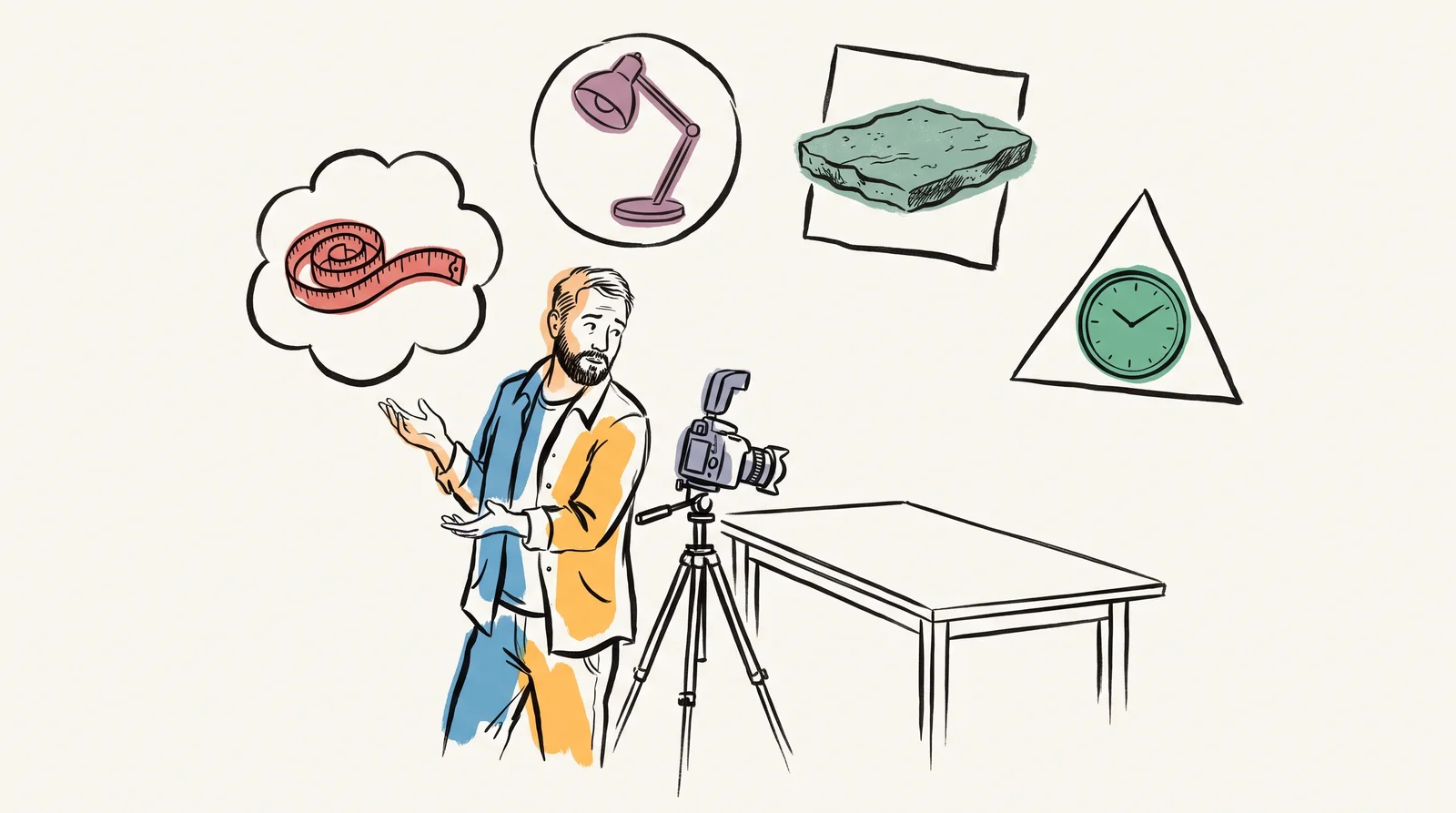
Give a photographer the words most people type into an image model and they would ask you six questions before touching a camera. They would want to know how far away the camera is, what time of day it is, what the thing is sitting on, who the picture is for, why it exists and what would count as wrong. A model asks none of them. It answers anyway, using the most common answer to each, and the most common answer is what generic looks like. This whole module rests on the idea that a is a , written for a collaborator who cannot ask you anything.
A brief, in an agency or a studio, is a short written statement of what a piece of work has to do, for whom, and what would count as wrong. Turned into a prompt it becomes a handful of plain decisions. There is the , the one thing the picture is about, described as exactly as you would describe it to a prop buyer. There is the setting and the surface underneath it, the distance and angle of the camera, the light and where it comes from, and the format the image will be used in. Then there is the , meaning what may not appear, which is the half of a brief that does most of the work. Each of these takes one line.
The job is to answer those questions before the model does, and the way to do it is by deciding things instead of adding adjectives. Adjectives are what everybody reaches for first. Compare 'a stunning, professional photo of a perfume bottle, luxury, 8k' with 'a 50 ml clear glass perfume bottle with a matt black cap, standing on wet grey slate, seen from a metre away at eye level, late-afternoon sun from the left raking across the glass, square frame for a product page, nothing else in shot'. The first is a wish made of , and it produces the same picture as everyone else's praise words. The second has made about ten decisions, and each one removes a choice the model would otherwise have made for you.
The companies that make these models say much the same thing in their own documentation. Google's guide to image generation with Gemini tells you to describe a scene in rich detail, because the more specific you are, the more control you have over the picture. Its template for a photorealistic picture names the type of shot, then the subject, then the setting, then the light, then the camera angle and the lens, which is almost the order a photographer's brief would take. Keep that order on any model. It puts the thing the picture is about first, and it gives every prompt you write the same structure, so a prompt that worked can be reused with one line changed when the model underneath is replaced.
The same logic holds when the collaborator is a language model writing copy, naming a product or drafting a shot list. Anthropic's guidance for its Claude models suggests treating the model as a brilliant but new employee who lacks context on your norms and workflows, and its golden rule is to show your prompt to a colleague with minimal context on the task, because if they would be confused, the model will be too. That is a good brief. Say who the work is for, what it will be used for, what good looks like and what to avoid, and include an example of something you liked whenever you have one.
A professional writes the brief before opening the tool, often as rough notes, and only then turns it into a prompt. When the first result comes back they judge it against the brief rather than against their mood, name the one decision that is wrong, and change only that line, because changing five things at once teaches you nothing about which of them mattered. They keep each prompt that worked alongside the picture it made, the model it ran on and the date. Over months, that becomes a library. A library like that outlasts any pack of magic words, because it records decisions about the brand rather than tricks that one model happened to like.
Try this
Six questions to answer before you type
Take the last image prompt you wrote. Under it, answer six questions in one line each: how far away the camera is, what time of day it is, what the product sits on, who the picture is for, why it exists, and what would count as wrong. Rewrite the prompt from those answers alone, deleting every praise word. Run the old and the new prompt twice each on the same model.
Time: 20 minutes.
Look for
- Which single answer moved the picture most.
- Whether deleting the praise words changed anything you can see.
- What the model still decided for you in the new version, such as the lens, the props or the weather. Those are the questions you left open.
- Whether the two runs of the old prompt differ more than the two runs of the new one. Every decision narrows the draw.
- Whether a photographer could now shoot it without ringing you.
The words, in plain language
- Brief
- A written statement of what the work has to do, for whom, and what would count as wrong.
- Prompt
- The same thing, addressed to a machine that will not ask you a follow-up question.
- Subject
- The one thing the picture is about. A prompt with three is a prompt with none.
- Constraint
- What may not happen. The half of a brief that does most of the work.
- Praise word
- An adjective such as stunning or professional. It states a hope and gives the model nothing to act on.
- Iteration
- Changing one decision between runs, so you learn what each decision does.
Why it matters
The failure people call bad output is nearly always an unwritten brief. Beautiful, stunning and professional are not decisions, and the model cannot act on them, so it fills every gap with its own average. That average is what generic looks like. It is being produced by the missing half of your sentence rather than by the model, which is why switching to a more expensive model so rarely fixes it.
Four habits cost beginners the most. The first is pasting in quality tags from prompt packs, strings like 8k or masterpiece, which were popular with older models and tell a current one very little. The second is putting three subjects in one prompt, which leaves the model to decide what the picture is about. The third is leaving out the constraint, so the model adds props, stray text or a second product, and a brand has to reject the picture however good it looks. The fourth is changing everything between runs. At a few cents a frame each habit seems cheap, but a morning of unfocused rerolling can burn through a hundred images and teach you nothing you can use next time.
There is a test worth running on every prompt before you spend money on it. Ask whether a photographer could shoot it. If your words describe something that could physically exist in a room, you have written a brief and the model has something to be accurate about; if they do not, you have written a wish. This also settles the argument about whether prompting is a skill that will disappear. The typing will go. Knowing what to ask for will stay, because that is art direction, and it was a job long before any of this existed.
The rest of this module builds each part of the brief in turn. It begins with describing a picture the way a photographer would, then covers the camera words that models respond to, and light treated as the subject. After that come telling a model what to leave out, working from a reference image, and which habits of wording still hold after a model is replaced. Later lessons deal with getting legible text into a picture, improving a result by directing it, and keeping a library of prompts you can reuse. The last three turn to language models, for creative writing, for answers in a fixed format a program can read, and for the attack called prompt injection. All of them start from the brief.
Elsewhere
- Type
- term
- Period
- ongoing