means you can download the model itself. The files are the trained parameters, often tens of gigabytes of them, and with them you can run the model on your own machine or on a rented one without asking anyone's permission for each clip. That is less than open source. The Open Source Initiative's definition (version 1.0, October 2024) asks for the parameters, the complete code used to train and run the system, and enough information about the training data that a skilled person could build a substantially equivalent model. None of the video models in this module publishes its training data, so none of them reaches that standard, whatever the launch post calls it.
It helps to see what arrives when you download one. A model's page on Hugging Face holds the weights as a set of large files, a model card explaining what the model does and how to run it, the configuration the code needs, and a licence file. Nothing runs by itself. You load the weights into software such as Hugging Face's diffusers library or the ComfyUI node editor, on a graphics card with enough memory to hold them, and the clip is made on that machine. With a hosted model such as Veo you rent access one clip at a time under the maker's terms of service, and the model never leaves the maker's servers. With open weights you hold a copy. It keeps working if a hosted service closes, as OpenAI's Sora API did on 24 September 2026, and unreleased product footage never has to leave a machine you chose.
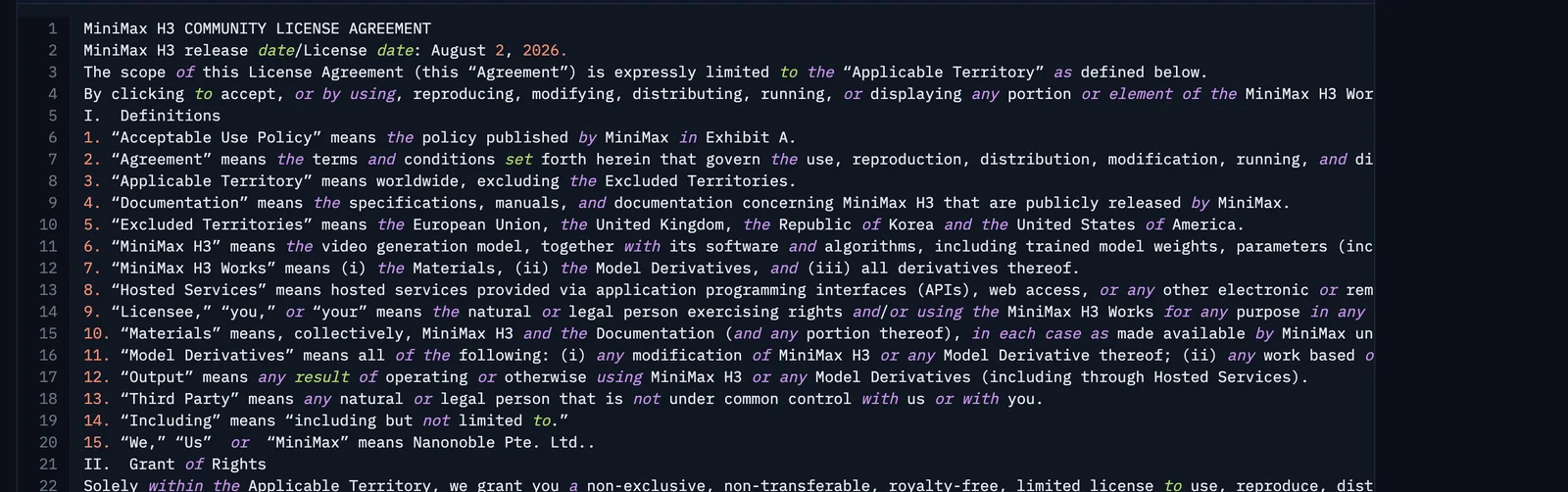
The licence decides what you may do. In September 2026 the current models sit under four very different kinds of licence. Wan 2.2 from Alibaba is Apache 2.0, which allows commercial use anywhere with no revenue cap. LTX-2.5 from Lightricks uses the LTX-2.x Community License, free for any organisation with annual revenue under $10 million once its affiliates are counted in, and paid above that line. HunyuanVideo-1.5 from Tencent grants nothing in the European Union, the United Kingdom or South Korea, and asks any company with more than 100 million monthly active users to request a licence. MiniMax H3, downloaded 3.6 million times on Hugging Face in the month to 25 September, excludes those three places and the United States as well.
Two of those are standard licences. Apache 2.0 and MIT were written for ordinary software long before video models existed, and both let you use, change and sell what you make with the weights, for any purpose and in any country. Their duties begin when you pass the weights on to someone else. MIT asks you to keep its copyright and permission notice with every copy. Apache 2.0 asks for the licence text, the original notices and a note on any file you changed, gives you a licence to the contributors' patents that ends if you sue over them, and grants no right to the maker's trade marks. Neither says a word about disclosure, territory or revenue, which is why a studio can put an Apache model to work on paid jobs without asking anyone.
are longer, and each one is different, so read them in a fixed order. Start with the definitions, because defined words such as affiliates, derivatives and decide how far every later clause reaches. Then find four clauses. The territory clause says where you may run the model and where its output may be shown. The threshold clause names the revenue or user count above which you need a paid or written licence, and the derivatives clause says what happens to a fine-tune or LoRA you make. The , often a separate page, lists what you may not generate. Note the date and version on each.
Here is the client-work version. Wan 2.2, the older Mochi 1 preview (Apache 2.0) and Meituan's LongCat-Video (MIT) can be used for paid work anywhere, and the main duty is to keep the licence and its notices with any weights you pass on. LTX-2.5 suits a studio under $10 million a year, but its section 3.5 says a fine-tuned LTX model or LoRA handed to a client above that line needs the client to hold its own paid licence first. Tencent's and MiniMax's terms reach past where the studio sits, because both forbid displaying the output outside their territory, so a HunyuanVideo clip made in Mumbai still cannot run in London and an H3 clip cannot run in London or New York. H3 also needs written authorisation above $20 million of yearly revenue, and requires 'MiniMax H3' to be shown in the interface of any commercial product built on it. CogVideoX1.5-5B needs you to register with Zhipu before commercial use and caps you at a million visits a month.

A real case
The day Civitai archived every SD3 model
Civitai and Stability AI · 2024
What they did
Stability AI published Stable Diffusion 3 Medium's weights under a licence that Civitai, a site where people share fine-tunes and LoRAs, said lacked clarity.
What happened
On 17 June 2024 Civitai temporarily banned every SD3-based model and LoRA, and anything trained on SD3's outputs, archived the ones already posted and sent the licence to its lawyers. Its worry was that the terms gave Stability too much power over fine-tunes. On 5 July Stability replaced them with a Community License, free for commercial use under $1 million a year in revenue, and said the original had caused confusion and concern.
What to take from it
Open weights are only as usable as their licence on the day you use them, and a hub can take files down over terms alone. Read the licence before you build on a model, and keep a dated copy.
The words, in plain language
- Open weights
- The trained parameters of a model, published for anyone to download and run, with no promise about the data or the code that produced them.
- Open source AI
- The Open Source Initiative's 2024 standard, which also asks for the full training code and enough detail about the training data to rebuild the model.
- Community licence
- A custom licence written by the model's maker, usually free below a revenue or user threshold and restricted above it.
- Excluded territory
- A place where the licence grants no rights at all, so running the weights or showing their output there is unlicensed.
- Output
- What the model generates; every licence in this lesson says the maker claims no rights in it, and every one still limits how you may use it.
- Permissive licence
- A short standard licence, such as Apache 2.0 or MIT, that allows commercial use anywhere and mainly asks you to keep its notices.
- Acceptable use policy
- The list of things a licence forbids you to make with the model, often kept on a separate page that can be updated.
Why it matters
Three traps catch people. The licence tag on a Hugging Face page is metadata typed by whoever uploaded the file, so a LoRA built on H3 can carry an apache-2.0 tag even though it cannot run without the H3 weights and their licence. The second trap is disclosure. The Lightricks, Tencent and MiniMax licences each forbid putting generated content into a public context without saying it is machine-generated, which means an ad cut from their output needs a label that a Wan clip under Apache 2.0 does not. The third is that terms move, as when Lightricks re-licensed its models on 11 August 2026, and MiniMax's own Q&A describes its territory list as 'not yet', not 'not ever'.
The sensible studio habit is one Apache-licensed model as the default for paid work, with the others kept for jobs that need what they do better, such as LTX-2.5 when the soundtrack has to come out of the same pass as the picture. Keep a dated copy of each licence. The LTX terms say the acceptable use policy in force at the time of use governs and that updates do not apply backwards, so the copy is your record of what you agreed to. Where an explainer and a licence disagree, the licence text wins. Comfy's H3 guide says commercial use of locally generated output requires a paid licence, which is stricter than the H3 licence itself, and Comfy sells that licence from $5,000 a month. This is a reading guide, not legal advice, and a real contract deserves a lawyer's eyes.
The rest of the module turns this into practice. It names the open video families worth knowing and what each one is good at, then shows how to read a Hugging Face model card and how to try a model free in the browser before you download anything. After that you run one in Python with diffusers, work out how much graphics memory a model really needs, and rent a GPU by the hour when your own machine falls short. ComfyUI comes after that. It is a node editor that saves each workflow as a file you can run again. Then you train a LoRA so that one character keeps the same face across clips, and the module ends with a routine for following new releases without chasing every one.
Elsewhere
Reading
- The Open Source AI Definition 1.0Open Source Initiativeopensource.org
- MiniMax H3 Community License AgreementMiniMaxhuggingface.co
- Q&A about the MiniMax H3 licenceMiniMaxhuggingface.co
- LTX-2.x Community License AgreementLightricksgithub.com
- Tencent Hunyuan Community License (HunyuanVideo-1.5)Tencentgithub.com
- Wan2.2 licence (Apache 2.0)Alibaba Wan teamgithub.com
- The CogVideoX LicenseZhipu AIhuggingface.co
- Type
- technique
- Period
- ongoing