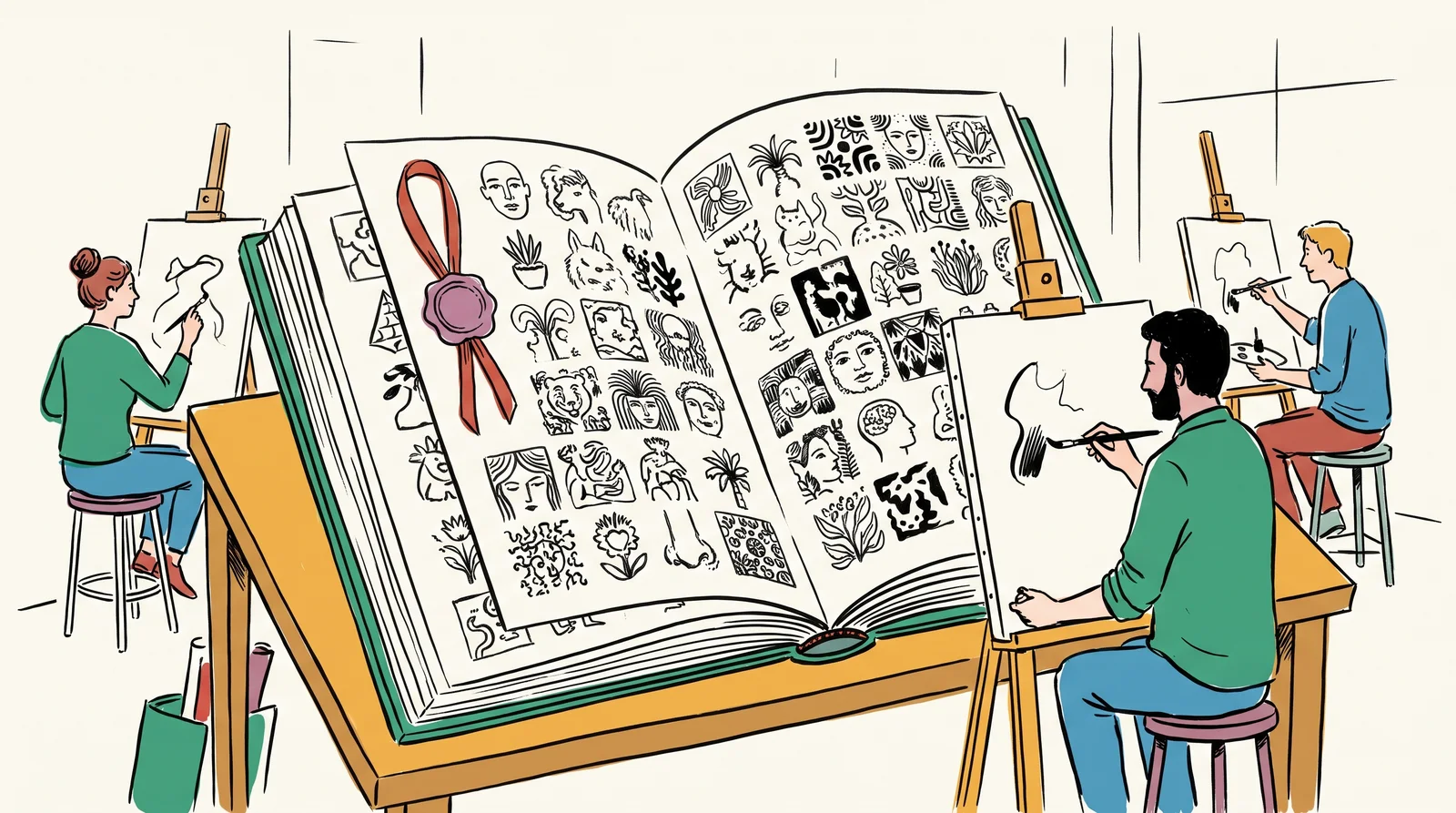
An image model learns by looking at pictures paired with words. During training it is shown hundreds of millions or billions of images, each with a caption, and it slowly adjusts itself until it can connect a phrase like 'linen shirt in morning light' with the patterns of pixels that tend to go with it. It keeps no folder of pictures. It keeps what it learned from them, which is why the question of what it was shown matters so much. A model that saw mostly English captions understands English prompts best, and a model that saw millions of product shots makes convincing product shots. What it can do, and what it gets wrong, both trace back to the .
For most large image models, that data came from the open web. The best documented example is LAION-5B, a public dataset released in 2022 that lists 5.85 billion links to images alongside their captions, gathered automatically from web pages across the internet and filtered with another model, called CLIP, that scores how well a caption matches its picture. It holds links and text instead of the images themselves. Over two billion of its pairs are in English. The first versions of Stable Diffusion were trained on subsets of that English portion, and their says so. So a great deal of work by living illustrators, photographers and designers went into training. Nobody asked or paid them. The papers themselves say where the images came from.
A scraped dataset holds whatever was online, including the worst of it. In December 2023 a researcher at the Stanford Internet Observatory found around a thousand links in LAION-5B pointing to suspected child sexual abuse material. took the dataset offline on 19 December 2023, and in August 2024 it released a cleaned version, Re-LAION-5B, with 2,236 suspicious links removed. Stable Diffusion's card adds its own warnings. It says the data contains adult material and was not de-duplicated, so the model shows some of repeated images, and that 'white and western cultures are often set as the default'. In 2023 researchers led by Nicholas Carlini extracted over a thousand training examples from models including Stable Diffusion, from photographs of real people to company logos.
A minority of makers built their models the other way and say so. Adobe states that its own Firefly models were trained on licensed content such as Adobe Stock, along with openly licensed work and public domain material. Getty Images' generator, built on Bria's Fibo Lite, was trained on images owned or licensed by Getty and named partner libraries, and its model card says none of it was scraped from the internet or made by another generator. These models trade some range for a clean answer. Getty's training data stops at October 2023. Several providers now offer legal indemnity to enterprise customers, which is a commercial admission that the question is real.
Between those two groups sits a large middle of models that publish their architecture and their licence and say nothing about the images. The model cards for SDXL base 1.0 and FLUX.1 [dev] are examples. That silence is itself an answer. The argument about all of this is still open, and both sides deserve a fair hearing. Supporters of training on public web data say a model learns patterns the way a student learns from looking, and that copyright covers particular works while leaving general lessons drawn from them free to use. Artists and photographers reply that their work was copied in full, without consent or payment, to build a product that now competes with them for the same commissions. Courts in several countries are hearing versions of both arguments.
Opting out is the main tool artists have, and it is weak. An only affects training that happens after it, and it works only where the trainer checks for it. In the European Union, the law lets rights holders reserve their work from commercial text and data mining, but a German court ruled in December 2025 that a reservation written in ordinary words on a website did not count, because software could not read it. So a working professional who publishes a portfolio puts the reservation where machines look, such as a robots.txt file or the TDM Reservation Protocol. They keep a dated record of when it went up, and they treat it as a request that some trainers will ignore.
Side by side
Four makers on what their models learned from
| What the maker says it was trained on | What that lets you tell a client | |
|---|---|---|
| Stable Diffusion 1.x (CompVis model card) | Subsets of LAION-2B(en), drawn from LAION-5B, a scrape of the public web. The card warns that the data holds adult material and was not de-duplicated, so some memorised images can come back. | The answer exists, and it is the uncomfortable one. Web images, gathered without asking. |
| SDXL base 1.0 and FLUX.1 [dev] (model cards) | The architecture and the licence. No statement of what the training images were. | Nothing. The gap is the answer, and worth saying out loud. |
| Adobe Firefly models (Adobe's Firefly FAQ) | Licensed content such as Adobe Stock, openly licensed work and public domain material. Stock contributors' files are in the set under their contributor agreements. | A clean line for Adobe's own models only. The partner models the Firefly app also offers, such as FLUX, GPT Image and Imagen, sit outside it. |
| Generative AI by Getty Images (model card, April 2026) | Built on Bria's Fibo Lite and trained on Getty's library and named partner libraries, all owned or licensed, and on nothing scraped or made by another generator. | The clearest answer here, with indemnity included. The price is a narrower model whose training data stops at October 2023. |
Read on 25 September 2026. Model cards change, so check the card for the exact version you use.
What to do it with
- Hugging FaceFree tier, paid above it
Where open models, datasets and demos live, with the licence on every model card.
Bad at Model cards are written by whoever uploaded the model. The licence line is the one to read carefully.
- Adobe FireflyFree tier, paid above it
Adobe's generative models, trained on licensed and public-domain material and wired into Photoshop and Illustrator.
Bad at Raw image quality trails the leaders. What you are buying is the indemnity and the fact that it sits inside files you already have.
- CivitaiFree tier, paid above it
A large library of community fine-tunes and adapters for open image models.
Bad at Provenance is frequently unclear and a good deal of it is trained on living artists without consent. Check before anything commercial.
- C2PA Content CredentialsOpen weights or open source
A standard for attaching a signed record of how an image was made and edited.
Bad at Stripped by most platforms on upload, so its promise is far ahead of its reality.
The words, in plain language
- Training data
- The images and captions a model learns from. What went in shapes what comes out.
- Web-scraped dataset
- Images and text collected automatically from public websites, at enormous scale.
- LAION
- An open dataset of links to billions of images with their captions. Under much of the open-model ecosystem.
- Licensed dataset
- Material the trainer paid for or owns. Rarer, and a selling point where it exists.
- Model card
- The maker's own document about a model. Where the training data is stated, or conspicuously left out.
- Memorisation
- When a model can reproduce a training image closely, usually one it saw many times. Rare, and demonstrated.
- Opt-out
- A way of excluding your work from future training. It only works where the trainer checks for it.
Why it matters
You will be asked. Clients in regulated industries, public bodies and large advertisers increasingly want to know where imagery came from, and some now write warranties about training data into their contracts. A studio that has thought about it answers in a sentence and names the model. One that has not either changes the subject or signs a promise it cannot back, and the second is the expensive mistake, because a warranty is a risk the studio carries long after the invoice is paid.
It also affects what you should be comfortable doing. Prompting in the name of a living illustrator uses a model that learned from their work to compete with them for the very commissions they rely on. Being easy does not make it neutral. This course's position, argued further in the lessons ahead, is that you should not do it, whatever the law allows.
Three smaller mistakes are common. The first is assuming that everything inside a commercially safe app is commercially safe. The Firefly app also offers partner models such as FLUX, GPT Image and Imagen, and Adobe's statement about licensed training covers only its own models. The second is reading indemnity as blanket cover, when it applies to paying business customers under conditions written in the contract. The third is trusting the output because the dataset was huge. A big scrape repeats the biases of the web it came from, and a model that treats white and western as the default will do the same in your campaign unless you direct it otherwise.
The rest of this module follows the question outwards. It looks at the court cases and where each has got to, who owns a generated image, and whether anyone can own a style. Then it covers faces, voices and consent, when to say that something was generated, and the signed records that show where a file came from. The later lessons turn to the people whose paid work has shrunk, a written policy for commissioning honestly while using these tools, the energy and water the models consume, and which rules are actually law today. None of it is legal advice. Each lesson tells you which questions to take to a lawyer.
Elsewhere
Papers
- LAION-5B: An open large-scale dataset for training next generation image-text modelsChristoph Schuhmann and others, 2022arxiv.org
- On the Dangers of Stochastic ParrotsEmily Bender, Timnit Gebru, Angelina McMillan-Major, Margaret Mitchell, 2021dl.acm.org
- Extracting Training Data from Diffusion ModelsNicholas Carlini and others, 2023arxiv.org
- Type
- term
- Period
- ongoing