A photograph makes a claim that a drawing does not. It says this existed, light came off it, and somebody stood in front of it with a camera. Viewers read that claim first. They have believed it since the daguerreotype was announced in Paris in 1839, and they do not stop believing it because a picture came from a model rather than a lens. Believability is the word for whether a generated image survives being read that way, and a viewer settles it at a glance, usually without being able to say what settled it.
A generated image fails in a predictable direction, because a model returns something close to the middle of the millions of pictures it learned from. The light arrives from everywhere at once. Skin is even and edges are crisp, and the background falls into one uniform blur that stops exactly at the subject's outline. Nothing carries grain. Each of those is a thing a camera would not do, and people who have never held a camera still feel it, which is why the usual verdict on a weak generated image is simply that it looks fake.
So the first habit a professional builds is to describe the photograph before the subject. That means deciding where the camera stands, how high it sits, how far back it is, which lens it carries and what format it shoots. A prompt that asks for a premium bottle of olive oil in beautiful light gets the average of every image ever captioned that way. A prompt that puts the camera at table height, a metre back, on a 90mm lens, with window light from the left, asks for one particular picture, and the model understands those words well because photographers have always described their own work in them. Height and distance also carry meaning, which the next lesson takes up.
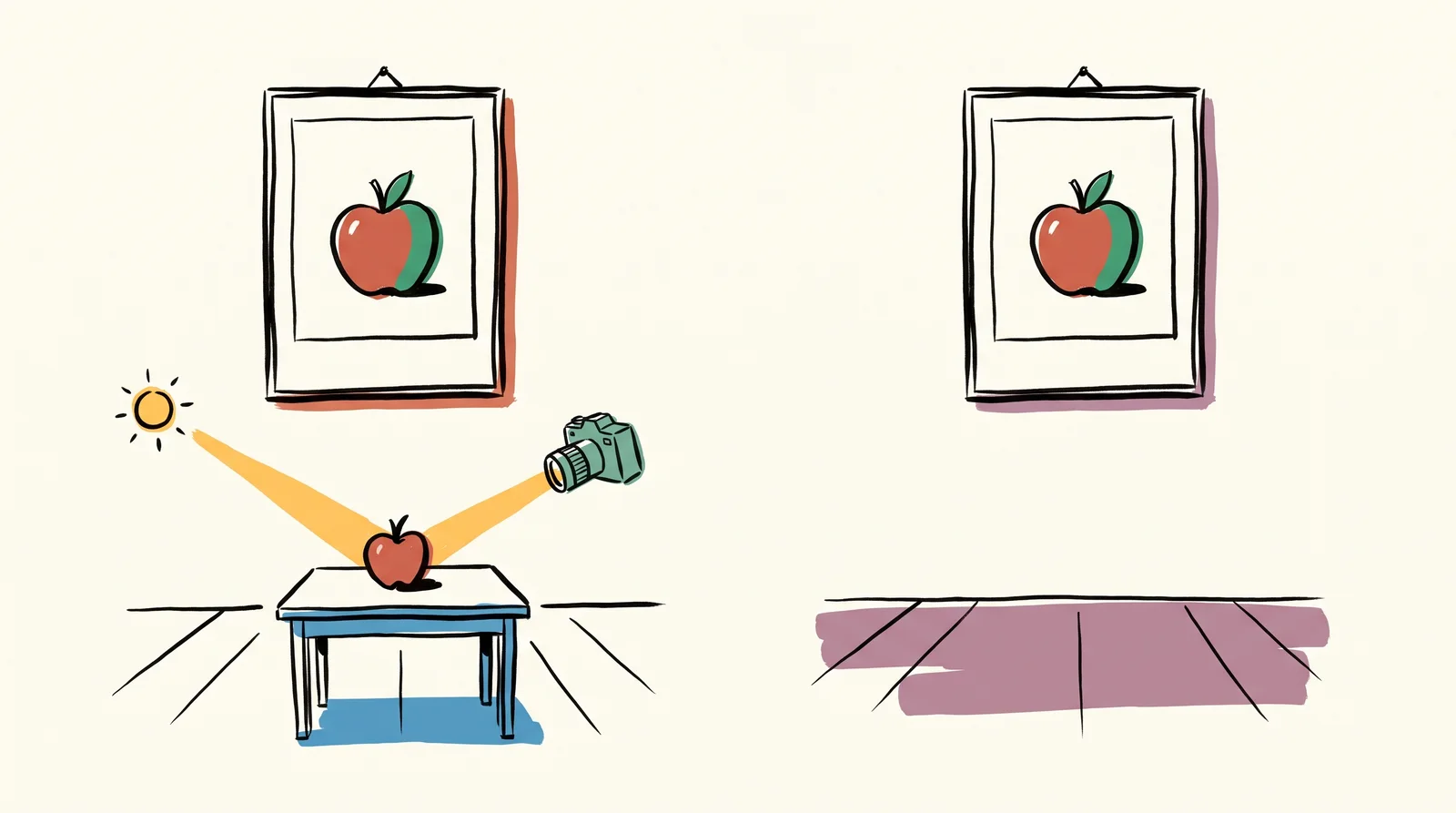
The second habit is to get the light right before worrying about detail. A real light source is one thing in one place, so it leaves one family of highlights on shiny surfaces and it falls off with distance according to the inverse-square law. Models blend thousands of lighting set-ups, which is why a generated bottle often carries three highlights that disagree about where the window is. Sharpness does not fix this. Turning up clarity or asking for hyper-detail makes it worse, and gives the waxy skin and crunchy edges people mean when they call an image plastic. A soft frame with one convincing light reads as a photograph.
The third habit is to put back what a camera would have recorded and the model left out. Real depth of field is continuous, so sharpness falls away gradually with distance, while a generated background is often one flat blur behind a cut-out edge. Real skin has pores, fine hair and uneven colour. Real pictures carry grain. When a person is in the frame, four checks in a fixed order catch most problems, so look at the hand where it touches something, the in both eyes, the colour cast on the skin, and whether the eye line goes where you asked.
Believable and true are separate questions, and a professional keeps them apart. A generated world behind a real product is a , and composites have been ordinary retouching practice for decades. A generated product is different. If the label came out of the model, the picture is making a statement about an object a customer is about to pay for, and models are weak at exactly the details that customer will check, such as small type and exact colour. So the working route starts from photographs of the real thing, taken on a phone by a window, which give the model something true to hold. The product is then composited into the generated scene rather than drawn by it.
The last habit is honesty. An image that looks like a photograph makes the photograph's claim whether or not a caption says otherwise, and on real events that claim is judged against every detail a witness would know. For a background or a mood, nothing has been misrepresented to anyone. For a product, a real person or a news event, a false photograph is a false statement, and a label added afterwards does not always repair it. , the provenance standard published by the C2PA, can record how an image was made, though some platforms still strip that information on upload. Decide which side of the line each job sits on before you start.
A real case
Real protests, generated photographs
Amnesty International · 2023
What they did
To promote its reports on police violence during Colombia's 2021 national strike, Amnesty posted AI-generated images of the protests on social media, one of them showing a woman being dragged away by police. The images carried text saying they were made by AI, and Amnesty said it used them to protect protesters from state retribution.
What happened
Photojournalists and media scholars warned that the images could undermine Amnesty's own work and feed conspiracy theories. The faces were smoothed and warped, the flag's colours sat in the wrong order and the police uniform was out of date. Amnesty removed the images, saying it did not want the criticism to distract from the victims.
What to take from it
The label did not rescue them. A picture that looks like a photograph makes a photograph's claim, and on real events that claim is judged against every detail a witness would know.
The words, in plain language
- Photographic claim
- The unspoken promise that light came off a real thing in front of a camera. A viewer reads it before reading the content.
- Indexicality
- The philosophers' word for a photograph's physical link to a real event. A generated image has none, however much it looks as if it does.
- Tell
- A detail that gives an image away as generated, such as highlights that disagree or a blur that stops at the subject's outline.
- Fall-off
- How light dims across a subject as the distance from the source grows. Even light front to back means no real source.
- Catchlight
- The reflection of the light source in an eye. In a real portrait both eyes agree on where the light is.
- Composite
- A picture built from more than one source, such as a photographed product placed into a generated scene.
- Content Credentials
- Provenance information, built on the C2PA standard, that records how an image was made and edited.
Why it matters
The commonest mistake is reaching for sharpness. Prompts full of 8K, hyper-detailed and ultra-realistic ask for more of the exact qualities that make an image read as a render, and the fix people then try is more detail again, which makes it worse. The cost is time. A client looks at the set, says something feels wrong, and the studio spends another afternoon rerolling without a note anyone can act on. Naming the fault in camera terms, as too high, too far, lit from everywhere or too clean, turns a mood into an instruction somebody can follow.
The expensive mistake is generating the product. It looks finished and passes a quick glance, and then the customer who receives the real thing notices that the colour or the pack is different. In the UK the Advertising Standards Authority applies the same rules on misleading ads however an image was made, and its guidance says an AI image showing a cosmetic effect that real use would not produce is likely to mislead even when the ad says AI was used. The EU's AI Act adds a separate duty to disclose deepfakes, which it defines as generated images that resemble real people, objects or places and would falsely appear authentic. Nobody accepts that the machine made the mistake.
The third mistake is using photographic realism where an illustration would have been honest and better. The Amnesty case below shows what happens with real events, where a label did not save images that got the flag and the uniform wrong. There is a craft reason too. An image that claims to be a photograph is judged against every photograph the viewer has ever seen, and most generated images lose that comparison, while one that is openly an illustration is judged on its own terms and often wins.
The rest of this module takes those habits one at a time. It starts with writing prompts camera first, then light and the clarity slider, then depth of field and the of fake background blur. Next come skin and why its flaws are worth keeping, the four checks for people, and grain. The later lessons are about the real product, covering how to shoot a reference set on a phone, how to composite a photographed product into a generated scene, and how to tell when a half day with a photographer would cost less than another afternoon of generating.
Elsewhere
- Type
- term
- Period
- ongoing