Directing a shoot runs in four stages, and most of what decides the pictures happens in the first two. Planning turns the brief into a written list of every picture the job owes. Preparation books the people, the location, the props and the clothes those pictures need, agrees the lighting with the photographer, and puts everybody's arrival time on a call sheet that goes out the day before. The day runs it against a clock. The wrap checks that nothing is missing before the set comes down, copies the files to two places and sends everything borrowed back to its owner. The is the one document that runs through all four stages.
A shot list is every frame the shoot owes, written down before the day, one line per picture. Each line answers the same questions. It says what is in the frame, which it belongs to (meaning the light and the background), what shape the frame has to be, where the picture will be used, and whether the job can ship without it. Shape deserves its own column, because it changes the composition rather than the crop. Meta recommends a 4:5 image for the Facebook feed and a 9:16 frame for an Instagram story, with roughly the top 14 per cent and the bottom 35 per cent of a story kept clear of text and logos, because the app lays its own buttons over those bands. A photographer who knows that in the morning composes a tall frame with room at the top and bottom. One who finds out afterwards gets a wide frame cut down, and a wide frame cropped tall is almost never right.
A working art director builds the list backwards, starting from the files the client will actually use. Say the job is three serums for a skincare brand that sells on its own website and on Amazon. Amazon asks for the main image on a pure white background (RGB 255, 255, 255) with the product filling at least 85 per cent of the frame, and it recommends at least six images for every product. Three serums at six images each is eighteen frames before anybody has talked about mood. Add a hero for the website, two feed posts, a story and close-ups of each serum's texture, and the list has its real size. Every line traces back to a use. A frame that serves no deliverable is a frame the day cannot afford.
Order is the next decision, and it is a practical one. Shots that share a light and a background are cheap to take together and expensive to go back to, so the list is grouped by setup and run in the order the set allows, which is rarely the order in which the campaign will present the pictures. Film works the same way. Productions schedule scenes out of story order and group everything at one location together, a practice the trade calls shooting out a location. On the serum job that means every white-background frame in one block, then the bathroom set with the model, then the texture close-ups on a small table with its own light. Relighting a white sweep that was already struck costs all the time it took to build.
The grouped list then runs the preparation. Count the setups rather than the frames, because the number of setups decides the length of the day. Ask the photographer how long each change will take and believe the longer answer. If the do not fit, the choice is to cut frames, add a day or simplify the setups, and that choice is far cheaper in a spreadsheet than at four in the afternoon. The same list tells the stylist which clothes each frame needs, gives the props buyer a shopping list and tells the producer who to call for when. The , a visit to the location beforehand, checks the plan against reality, such as where the sun falls, where the sockets are and whether a tall frame fits under the ceiling.
On the day the list becomes the running order and the scoreboard. Mark the and shoot them early in each setup, because energy, light and time all run down across a day, and a shoot that saves the hero frame for the end gets its hero from the tired hour. Name the in advance too. When the day runs long, cutting them is a decision already taken rather than an argument at five o'clock with the client watching. Print the list and tick it on the floor. A list on somebody's laptop in the corner is a list nobody checks, and its real value comes at the wrap, when it is read line by line before the set comes down.
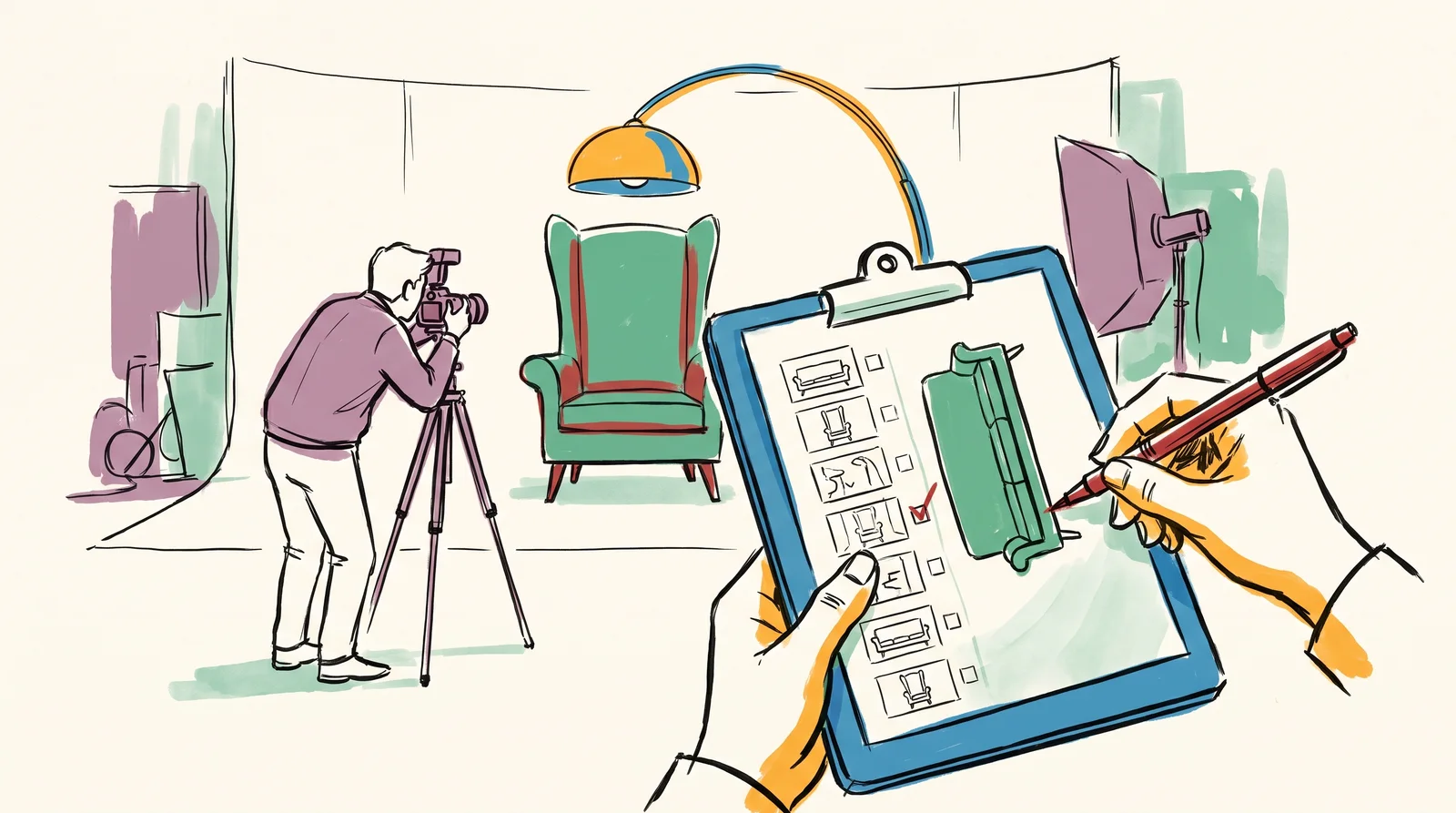
Worked example
Build a shot list for a one-day shoot
- 01List every file the client will use, with where it runs and its shape, such as a 16:9 website hero, a 4:5 feed post, a 9:16 story or a marketplace image on white.The list is built backwards from use. A frame with no use is a frame the day cannot afford.
- 02Turn each file into a line that says what is in the frame, its shape, where it runs, and whether the job can ship without it.Deciding the shape now lets the photographer compose for it instead of cropping a wide frame later.
- 03Give every line a setup letter, A for the white sweep, B for the bathroom set and so on, then sort the list by letter.Shots that share a light and a background are cheap together and expensive to come back to.
- 04Count the setups, ask the photographer how long each change takes, and add up the day.The turnarounds decide how much fits. If the total runs over, cut frames or add a day now.
- 05Mark each line as a must-have or a nice-to-have, and move the must-haves to the front of their setup.Energy and light fade across a day. The hero should come from the fresh hours.
- 06Order the setups so none is built twice, and put any setup that needs daylight at the hour the light is right.The sun keeps its own schedule. The recce tells you where it will be and when.
- 07Send the list to the photographer, stylist and producer before the call sheet goes out, then print it for the day.Each of them plans their own work from it. On the floor, a printed list gets ticked and a list on a laptop gets forgotten.
What to do it with
- ClaudeFree tier, paid above it
A language model that writes, edits, reads long documents and runs tools, including agents that work inside a codebase.
Bad at It is agreeable by default, so it will improve a bad idea instead of telling you it is bad. Ask it to argue against you and the quality of the answer changes.
- Capture OneSubscription
Raw processing and tethered capture, with colour handling professionals prefer to the alternative.
Bad at Priced for working photographers and organised the way they think. A designer will find the catalogue alien.
- FigJamFree tier, paid above it
A whiteboard next to the design files, for workshops, maps and the argument before the work.
Bad at A workshop board is a record of a conversation, not a decision. Somebody still has to write the decision down.
The words, in plain language
- Pre-production
- Everything done before the shoot day. The list, the bookings, the recce and the call sheet.
- Shot list
- Every frame the shoot owes, written down before the day, one line per picture.
- Setup
- One arrangement of light and set. Changing it costs time; shots within it are cheap.
- Turnaround
- The time it takes to change from one setup to the next. The unit a shoot day is really measured in.
- Must-have
- A shot the campaign cannot ship without. Shot first, not last.
- Nice-to-have
- What gets cut when the day runs long. Named in advance so the cut is not a panic.
- Recce
- A visit to the location before the shoot, to check the light, the space, the power and the access.
Why it matters
Without a list, a shoot is organised by memory and mood, and both fail in the same places. The frame everybody assumed somebody else had taken turns up missing three weeks later, by which time the set has been struck, the model is booked elsewhere and the borrowed clothes have gone back. A reshoot costs the whole day again. The frames most often missing are the ones in an unusual shape, which is why the list gives shape a column of its own.
The usual mistakes are easy to spot on paper. A list ordered by importance rather than by setup wastes hours rebuilding things. A list that names subjects but no shapes leaves the composition to chance. A list with no priorities treats a detail shot as equal to the hero, so the day cuts whatever happens to come last. The fourth mistake is optimism. Sixty frames planned against a day that fits thirty guarantee that the last hours are rushed, and the frames shot fastest are often the ones the client wanted most. Write fewer lines and shoot them properly.
A list is a plan, and it should never become a cage. The reason to plan the must-haves tightly is that it buys time for the frame nobody planned. When the hero is safe by eleven, the photographer can chase the light that has just come through the window, or the moment the model laughed between takes, and those are often the pictures a campaign ends up running. End every setup on an open line. It is ten protected minutes for whatever the day offers.
The module goes deeper from here. It starts with boards and previsualisation, drawing or generating the frames before the day so the composition is settled while it is cheap. It covers the call sheet, the real shape of a shoot day, and how to direct a model and a photographer so that each does their best work. Then it turns to coverage, meaning the extra frames that save you later, and to tethering, selects and a client watching on set. It ends with what to fix on the day and what to leave for retouching, planning for weather and delay, and the wrap, when the files and the borrowed things leave the building.
Elsewhere
- Type
- term
- Period
- ongoing