A brand is stored in memory as a cluster of linked associations: a name, a colour, a shape, where it sits in the shop, roughly what it costs, the time it let you down. Psychologists call this an associative network. Kevin Lane Keller put it at the centre of brand theory in a 1993 paper in the Journal of Marketing, where he described what a customer knows about a brand as two things, awareness of it and a set of associations attached to it in memory. Guidelines describe a plan. The brand that actually sells is whatever is in people's heads when they buy.
Memories are reached through cues. One idea switches on the ideas linked to it, a process Allan Collins and Elizabeth Loftus described in 1975 as spreading activation. Endel Tulving and Donald Thomson showed in 1973 that a memory comes back most easily when the cue at the moment of matches what was present when it was learnt, which they called encoding specificity. For a brand this has a practical meaning. Nobody searches their memory for your name in the aisle. Something in the moment, a red can in a chiller or the thought of a quick lunch, has to reach in and pull the brand out.
The most useful distinction in this module is between and recall. Recognition is knowing a brand when it is in front of you, and it is easy. Recall is producing the brand from memory with nothing in front of you, which is much harder and much rarer, and Keller treated the two as the separate halves of awareness. They are built differently and they fail differently, so it matters which one a purchase depends on. A supermarket shelf mostly tests recognition. A smart speaker asked to reorder washing powder, or a friend asking where to buy a good sofa, tests recall.
Memory keeps the gist and drops the detail, which surprises most designers. In 2015 psychologists at UCLA asked 85 students to draw the Apple logo from memory, and only one drew it correctly, although most of them were Apple users. Fewer than half could pick the real logo out of a line-up of near misses. Raymond Nickerson and Marilyn Adams found the same with the American penny in 1979. People keep a rough colour and shape. So a brand is recognised by the few features that survive this compression, which is why one strong colour or silhouette does more work than a detailed mark.
Byron Sharp and his colleagues at the Ehrenberg-Bass Institute in Adelaide built a theory of growth on this. In How Brands Grow, published in 2010, Sharp argued that brands grow mainly by being easy to think of in buying situations, which he called , and easy to buy, which he called physical availability. Six years earlier Jenni Romaniuk and Sharp had defined brand salience as a brand's propensity to be noticed or come to mind in buying situations. They pointed out that the usual awareness question tests one cue, the name of the category. Real buying offers dozens. A brand linked to more of them gets retrieved more often, by more people.
Two more findings explain why brand work is so repetitive. Daniel Kahneman, in Thinking, Fast and Slow (2011), described most everyday judgement as fast and automatic, and that fast mode treats familiarity as a sign that something is safe and true. Memories also fade without use. Hermann Ebbinghaus measured forgetting on himself in 1885 and found that most of it happens soon after learning, and a replication published in 2015 found the same curve. A brand that goes quiet for a year hands its place in memory to whoever kept showing up. One caution belongs here. Parts of the behavioural literature have not replicated, and Kahneman wrote in 2017 that he had placed too much faith in underpowered studies of priming, so ask for the study behind any striking claim.
Try this
Test recall and recognition on five people
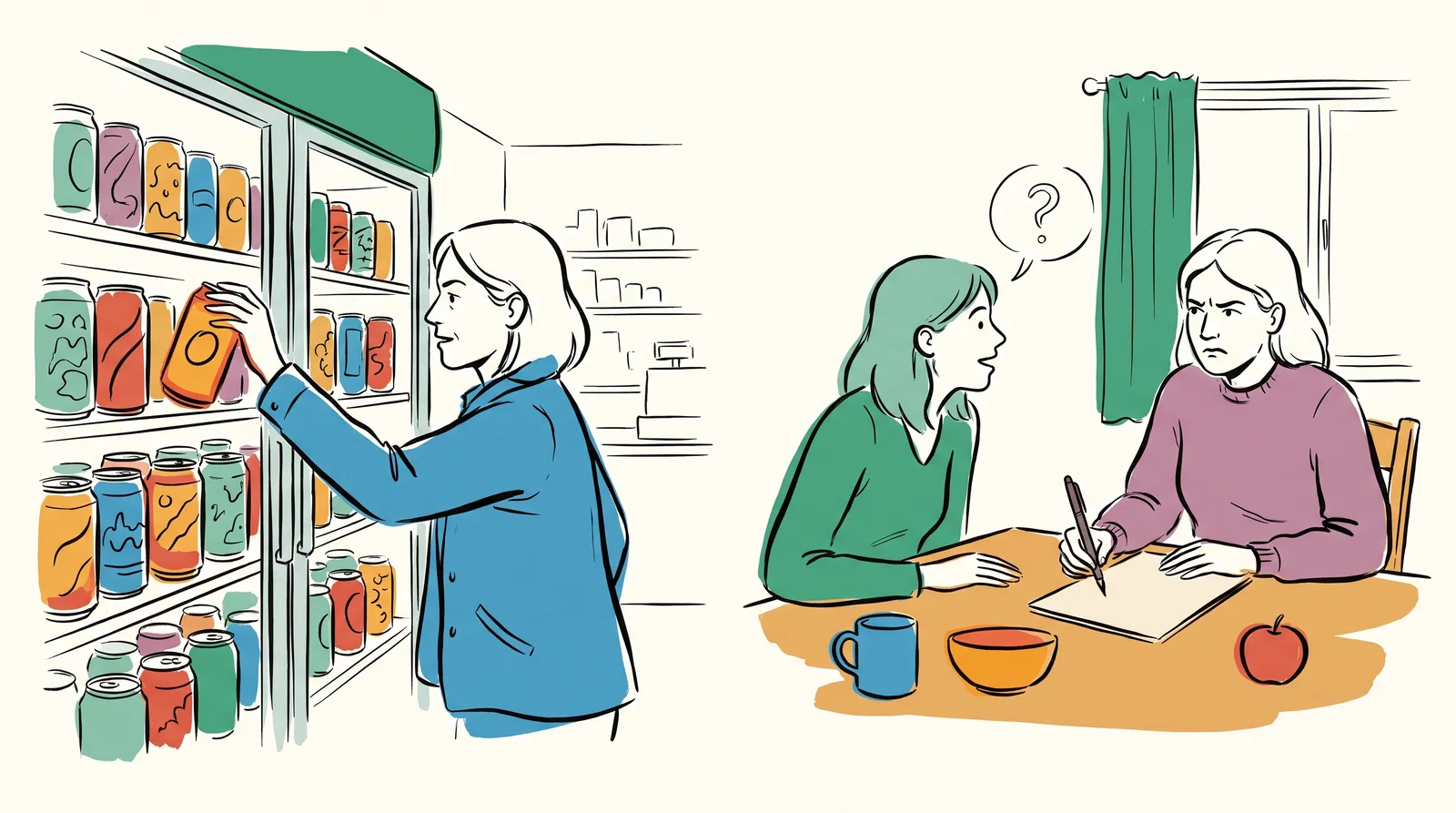
Pick a category you know as a buyer, such as crisps, running shoes or banking apps. Photograph six products from it and cover or crop out every brand name. Then sit with five people who are not designers, one at a time. First ask each of them to name the brands that come to mind for one specific moment, such as a snack on a long train ride, and write the answers down in the order they come. Next, show the six covered photos and ask whose each one is. Last, give them one minute to draw the market leader's logo from memory.
Time: 40 minutes. You need: Five people who are not designers, Six product photos with the names covered, Paper and a pen for the drawings.
Look for
- How short the unprompted lists are, and how often the same brand comes first.
- Brands people recognise at once from a covered photo but never named in the first question. That gap is recognition without recall.
- What gave each covered brand away: a colour, a shape, a character, a typeface. Those are the cues doing the work.
- Any covered product people credit to the wrong brand. Its cue belongs to the category rather than the brand.
- How the list of named brands changes if you swap the train snack for a party.
- The drawings. Expect the rough colour and shape and very little detail, as in the UCLA study of the Apple logo.
What to do it with
- ClaudeFree tier, paid above it
A language model that writes, edits, reads long documents and runs tools, including agents that work inside a codebase.
Bad at It is agreeable by default, so it will improve a bad idea instead of telling you it is bad. Ask it to argue against you and the quality of the answer changes.
The words, in plain language
- Memory structure
- The network of associations a brand occupies in somebody's head. Colours, places, occasions, feelings, all linked to the name.
- Cue
- Something that brings the brand to mind. A colour, a sound, a situation.
- Retrieval
- Getting the brand out of memory at the moment of buying. The whole game.
- Recognition
- Knowing the brand when it is in front of you. Easy, and usually enough on a shelf.
- Recall
- Producing the brand from memory with nothing in front of you. Harder, and needed wherever there is no shelf.
- Mental availability
- How easily a brand comes to mind, in how many buying situations. Byron Sharp's term.
Why it matters
This is why consistency beats novelty in most brand work. A is built by repetition, and a brand that changes its look every eighteen months is rebuilding rather than reinforcing. Tropicana's carton of 2009 is the famous case, told in full in "Rebrands that were reverted". In this lesson's terms, the orange with the straw was the cue shoppers had learnt to look for in the chiller, so when it went, the memory had nothing in the moment to match.
Cues are the practical output of all this. For any brand, list what a buyer sees, hears and feels at the moment of choosing, then check whether any of it points to you. Designing backwards from the buying situation is more useful than designing forwards from a list of brand values, because the situation is where happens. A beer is chosen at a crowded fridge, a bank in a moment of worry about money, an app from a small grid of icons on a phone. Each has cues you can own.
The common mistakes all come from forgetting how memory works. Teams test a new identity on a large screen in front of people who have been told what it is, which tests nothing a shopper will ever do. They chase recall when the sale happens in front of the product, where recognition is cheaper and usually enough. They retire assets that were working because the team is bored of them, long before customers have properly learnt them. Each of these wastes money quietly. Nothing breaks on launch day, and the loss shows up months later as a brand that is slightly harder to find.
The later lessons build on this. They go deeper into mental availability and the situations that make people think of a category, then into measuring which of a brand's assets people actually link to it. They cover fast and slow thinking, why easy-to-read things feel true, how the first price someone sees shapes the rest, and when showing what other people do helps or backfires. Then the module turns to habit, the evidence on emotion in advertising, and why the popular archetype frameworks rest on thin evidence. It ends with the biases designers bring to their own judgement, and how to run a small test whose result could change your mind.
Elsewhere
Papers
- Type
- term
- Period
- ongoing