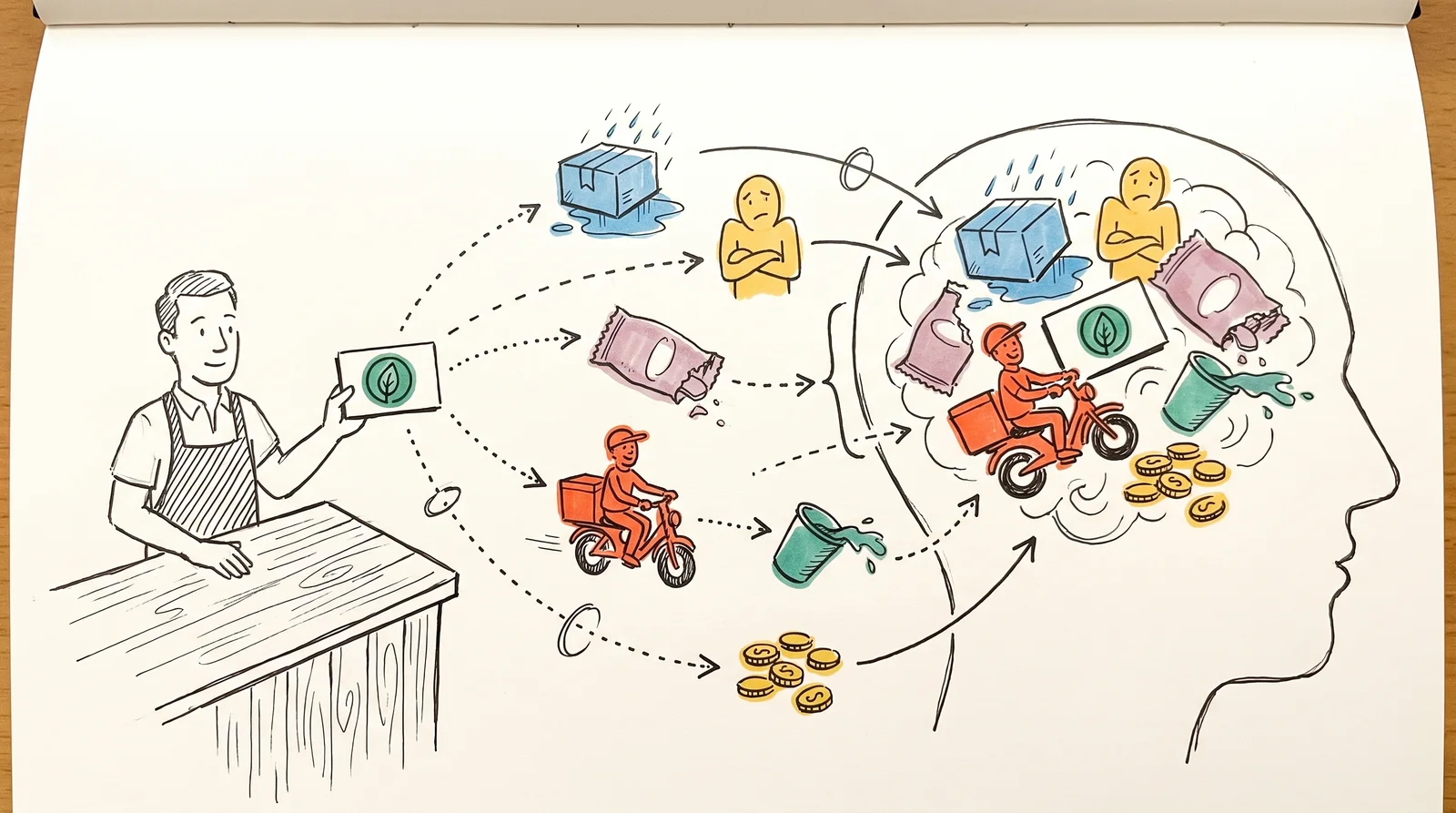
The word began as fire. In Old English a was a burning piece of wood, and by the 1550s it also meant the mark a hot iron left to show who owned something or made it. The American Marketing Association still defines a brand from the seller's side, as any distinctive feature like a name, term, design, or symbol that identifies goods or services ama.org. Strategists use the word for something wider. They mean what a person remembers and expects on meeting that sign, and whether the brand comes to mind at all when they need something. So keep three words apart from the start. The logo is one mark, and the identity is the designed system of marks, colours, type, pictures and words that the company controls. The brand is what strangers make of all of that, together with everything the company never designed, such as a late delivery or a friend's opinion.
Coca-Cola learnt this in public in 1985. The company had tested a new formula on nearly 200,000 consumers, who preferred it, and on 23 April it announced the first change to the recipe in 99 years. Complaints grew until the hotline was taking 1,500 calls a day by June. On 11 July, 79 days after the launch, the old formula came back as Coca-Cola Classic. The taste tests had measured the drink and missed the memories attached to the name. A study in the journal Neuron in 2004 caught the same effect in a brain scanner. Researchers at Baylor College of Medicine gave 67 people Coke and Pepsi, and telling them that a drink was Coke changed which one they said they preferred and activated brain areas including the hippocampus, which is involved in memory. The Pepsi label made no such difference.
Most of the field agrees on how this works, even where it disagrees about what to do. A brand is stored in memory as a web of linked associations, such as a name, a colour, a price and the time it let you down. Nobody searches their memory for a brand in the abstract. Something in the moment reaches in and pulls a brand out, like needing something to take to a dinner, something for a hangover or someone to fix a leaking tap on a Sunday. Researchers call these moments . A brand linked to more of them comes to mind more often and for more people, and Byron Sharp calls that likelihood . Its partner is , meaning how easy the brand is to find and buy once somebody wants it.
The disagreement is about what a brand should put into those memories, and there are two serious schools. The older one says a brand wins by meaning something clear and different. David Aaker's Managing Brand Equity, published in 1991, treated a brand as assets linked to its name and symbol that add value to a product, and strategy as choosing which associations to build. Al Ries and Jack Trout had argued earlier, in a series for Advertising Age in 1972 and in their 1981 book , that the contest is fought in the customer's mind, which keeps room for very few names in each category. The best-known example is older still. In 1962 Hertz was the largest car-rental company, and Avis ran advertisements that admitted it was number two and promised that it tried harder. This school's first question is what the brand stands for, for whom and against which rivals.
The newer school comes from the Ehrenberg-Bass Institute in Adelaide and from Byron Sharp's en.wikipedia.org book How Brands Grow of 2010. It starts from purchase data, where the same patterns turn up across categories and decades. Under the double jeopardy law en.wikipedia.org, small brands suffer twice, because they have fewer buyers and those buyers buy them slightly less often. Customer bases overlap in proportion to market share, so your buyers are mostly other brands' buyers too. Loyalty varies far less between rivals than marketers expect. The school concludes that most buyers hold few detailed beliefs about any brand, so brands grow by reaching many light buyers and by being easy to recognise at the moment of choice. Jenni Romaniuk calls the colours, shapes, characters and sounds that do the recognising distinctive brand assets. Coca-Cola understood this in 1915, when it asked glass makers for a bottle so distinct that you could recognise it by feel in the dark or lying broken on the ground. The contour bottle was patented that November.
The two schools still argue, and good strategists use both. Positioning does its best work on decisions inside the company, such as what to make, who it is for, what to charge and which rivals to be compared with. Distinctiveness does its best work on what the outside world sees and hears, because it asks whether a hurried stranger can pick the brand out and remember it next time. The two sides share two beliefs. Both say a brand is built in memory, and both say it is built by doing the same things consistently for years. A company that follows only one school tends to overspend on it, on purpose statements nobody outside the building remembers or on a recognisable look attached to a product nobody has a reason to choose.
Try this
Find out what a brand is in other people's heads
Pick a brand you know well, your own or one you would like to work on. Find five people who buy in its category and do not know you well, and ask each of them three things in this order, writing down their answers in their own words. First, ask when they last bought something like this and what was going on at the time. Second, ask which brands came to mind for that moment. Third, say the brand's name and ask what comes to mind. Do not show them the logo or the website until all three are answered.
Time: About an hour, spread over a day. You need: Five people who buy in the category and are not your friends or colleagues, a notebook or voice memos, your own list of six to eight buying situations, written before you start.
Look for
- Which buying situations brought the brand to mind unprompted, and which never did. The gaps are where it is invisible.
- Which competitor came up first in each situation, because that is the brand you are actually up against.
- Any colour, shape or phrase people mentioned without being asked. That is a distinctive asset, whether the company knows it or not.
- How many answers were about the product and the service, and how many were about the logo or the advertising.
- Where people's words differ from the words on the brand's own website. The difference is the brand as it actually exists.
The words, in plain language
- Brand
- What people remember, expect and feel when they meet a company's name or its signs. It lives in their heads, so the company can influence it but never fully control it.
- Positioning
- The place a brand chooses to hold in buyers' minds, for a named group of people, against named rivals.
- Distinctive asset
- A colour, shape, character, sound or phrase that people link to one brand without being shown the name.
- Mental availability
- How likely a brand is to come to mind when someone is buying. Liking has little to do with it.
- Physical availability
- How easy a brand is to find and buy. The half of brand growth that is logistics rather than design.
- Category entry point
- The situation that starts a purchase, such as late-night hunger, a leaking tap or a new baby. Brands are remembered against these moments.
- Salience
- The range of buying situations in which a brand comes to mind first. It is a different thing from fame.
Why it matters
In a business, a brand shows up in three places. It shows up in the price the company can charge, in what it costs to win each sale, and in what the company is worth to a buyer. The accounts often cannot see it. Under IAS 38 ifrs.org, the international accounting standard for intangible assets, a brand that a company builds itself is not recognised as an asset, because the spending that built it cannot be separated from the cost of running the business. A brand bought in an acquisition does go on the balance sheet, because a price was paid for it. So judge brand work on evidence, such as whether more buyers recognise you and think of you, and not on how the launch felt.
The most expensive mistake is treating the brand as the logo. A company with slow refunds and a beautiful new identity still has a bad brand, because customers build it from everything they meet, including the delivery, the packaging and what a friend said. Redrawing a mark to fix a problem in the service costs months and changes nothing a customer cares about. The next mistake is building for love. Almost nobody loves a brand. People recognise it, it is close enough, and they have a few seconds in front of a shelf or a screen. Work built to be loved tends to flatter the people who made it, while work built to be picked out in a supermarket at six in the evening tends to survive.
The third mistake is a brand attached to only one situation. Write down the six or eight moments in which someone might buy what you sell, and ask honestly which of them your brand is linked to today. Most young brands are attached to exactly one, usually the founder's own reason for starting, and are invisible in the rest. The fourth is impatience: teams change their assets just as they begin to work, and customers then have to learn the brand again from nothing. Why teams tire of their own look so early is explained in "Building consistency without monotony", and Tropicana's carton of 2009, told in "Rebrands that were reverted", shows the price. For a small brand the biggest competitor is usually the customer forgetting it exists.
The rest of this module is the thinking that comes before any drawing. It opens with short cases, then goes deeper into positioning and into measuring which assets people link to a brand. After that it covers auditing a category, choosing an audience, finding an insight and writing mission, vision and values. It weighs brand purpose and differentiation against the evidence, then covers brand architecture, the models agencies use to summarise a brand, category codes and brand equity. It ends with writing a brief and running a discovery session. The course then moves on to naming. After naming come how a brand sounds, the identity system, the brand book and packaging. Then the identity is rolled out onto signs, stationery, vans, uniforms, screens and adverts, the work behind the project's last step. After that come how brands in a portfolio relate, what research says about memory, the worlds brands build around themselves, the vocabulary of the trade and rebrands.
Elsewhere
Reading
- Type
- term
- Period
- ongoing