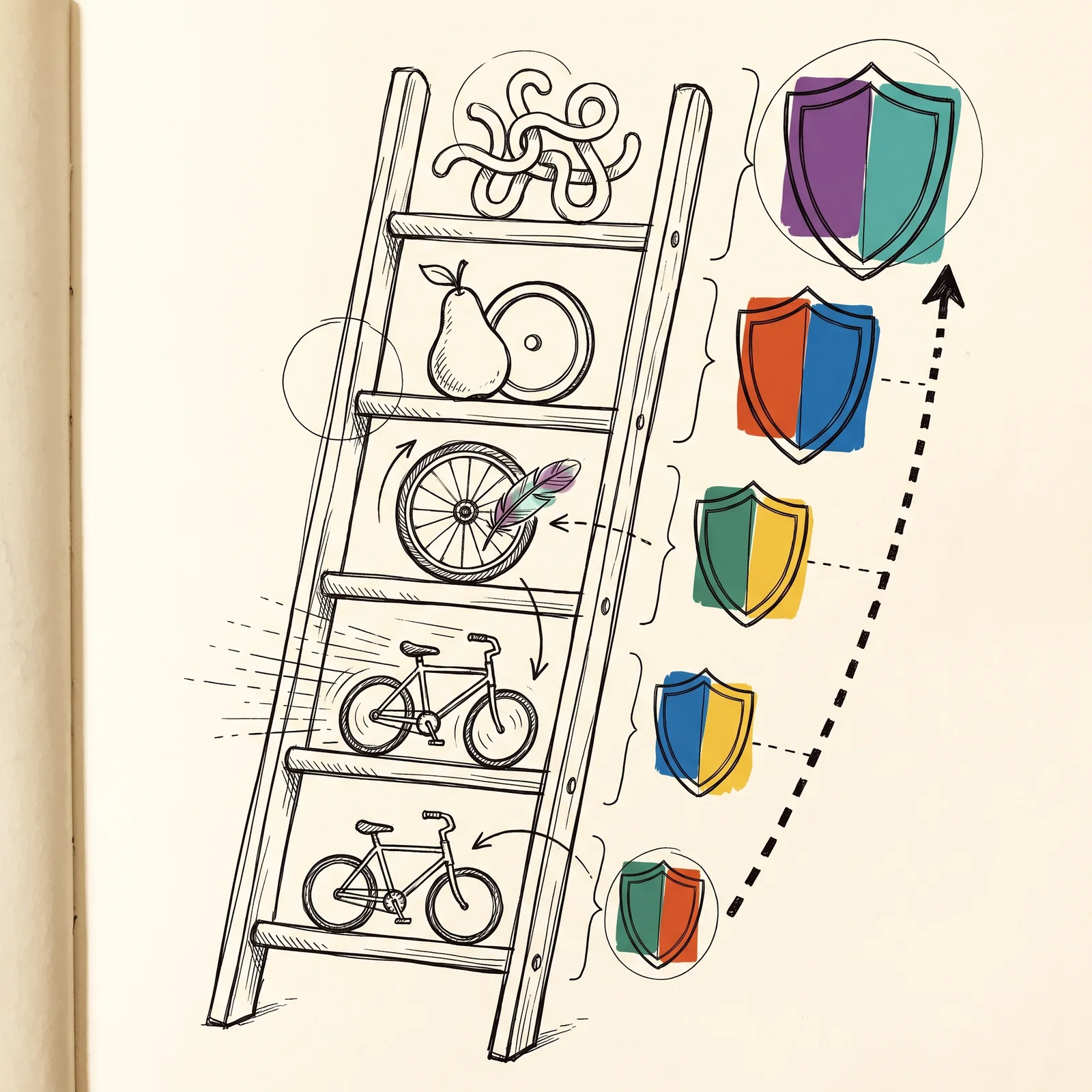
Every brand name sits somewhere on a scale that runs between plainly saying what the product is and meaning nothing at all. Designers and lawyers use the same scale, and it comes from American trademark law. Judge Henry Friendly set it out in Abercrombie & Fitch v Hunting World en.wikipedia.org in 1976, and it runs , , , , , in rising order of how much protection the law will give. The United States Patent and Trademark Office still teaches it with plain examples. Bicycle for bicycles is generic, Creamy for a yoghurt is descriptive, Coppertone for suntan lotion is suggestive, Apple for computers is arbitrary, and Exxon and Pepsi are fanciful. The two ladders point the same way. A name that is hard to protect is usually easy to forget as well.
The bottom two rungs are weak. A generic name is the category word itself, so nobody can own it, and a famous brand can slide down onto that rung by its own success. Escalator, aspirin and thermos en.wikipedia.org were all registered marks in the United States that became the everyday word for the thing and lost their protection there. A descriptive name says what the product is or does, which makes it cheap to explain and hard to protect. It can be registered only after it has through use, which in practice means years of trading and evidence that buyers read it as one company's name. Until then, a competitor is free to describe its own product in the same words.
The top three rungs are protectable from the first day, and each has a different cost. A suggestive name hints at the product without stating it, so a buyer makes a small leap, as with Coppertone for suntan lotion. An arbitrary name is a real word with no link to what is sold, like Apple for computers, and it is easy to say and spell because people already know the word. A fanciful name is invented. George Eastman made up Kodak by trying combinations of letters that started and ended with K, which he said seemed a strong, incisive sort of letter, and the word was first registered as a trademark in 1888. An invented word gets the strongest protection, but it arrives empty, and the brand has to pay to fill it with meaning.
Designers also sort names by how they are built, and these types cut across the legal scale. A founder's name, such as Ford or Chanel, carries a person's reputation. Initials, such as IBM for International Business Machines or HSBC for the Hongkong and Shanghai Banking Corporation, usually shorten a long name that was already famous. A blend joins two words, as Microsoft joined microcomputer and software. Borrowed words, such as Nike from the Greek goddess of victory or Amazon from the river, lend a feeling without describing anything. Each carries its own legal risk. In the United States a name that is primarily merely a surname is refused registration until it has acquired distinctiveness, which puts a founder's name alongside descriptive ones.
The real decision is a trade between explanation and ownership. A descriptive name does free marketing on day one, since a stranger reading it on an invoice knows what you sell, and then it charges rent for as long as you keep it. You cannot stop a competitor describing itself accurately, the matching domain is expensive or gone, and the name quietly fences in the company. A business called something-plus-Delivery will struggle to sell software later. An invented name is the opposite deal. Nobody knows what it means, so you pay to teach it, and the cost can be most of your marketing budget for years. What you get is a word you own outright, with a clean registration, a better chance of a free domain and no ceiling on what the company can become. Most good names sit in the suggestive band, because they borrow a little meaning without giving up protection.
A professional also asks who the name belongs to, and for how long. A founder's name feels personal and warm, and it can be sold away from the person. After Kate Spade sold the company that carried her name, which later passed to Liz Claiborne, she could no longer use that name commercially, and her next label was called Frances Valentine. Companies and products raise a separate question. A company name has to last through everything the business may become, while a product name only has to sell one thing, so the best answer is often two different names. Decide which one you are naming first.
Side by side
Seven ways to build a name, side by side
| Examples | Works best when | Watch out for | |
|---|---|---|---|
| Descriptive | General Motors, British Airways | Buyers need to know at once what you do, and there is little money to explain it. | Rivals can describe themselves the same way, and the name fences in what the company can become. |
| Founder's name | Ford, Chanel | The founder's own craft or reputation is what customers are buying. | A surname alone is weak in law, and the name can be sold away from the person. |
| Initials | IBM, HSBC | A long name is already famous and needs shortening. | Three letters mean little to a stranger, and most short combinations are taken somewhere. |
| Blend | Microsoft, Netflix | Two plain words together say something neither says alone. | The obvious blends occur to every competitor too, so search the register early. |
| Suggestive | Coppertone | You want a head start on meaning and still want to own the name. | A hint that is too direct slides into descriptive, where protection weakens. |
| Arbitrary | Apple for computers | You want a word people can already say and spell, with no link to the category. | It starts with no meaning for your product, so the brand has to supply it. |
| Invented | Kodak, Exxon, Pepsi | There is a budget and time to teach a new word, and the company may range widely. | It costs the most to teach, and it must be easy to say on first reading. |
The same name can sit in two rows. A blend of two descriptive words can still be treated as descriptive in law, which is one reason blends need an early trademark search.
The words, in plain language
- Generic
- The category word itself. Never registrable, and a brand name can slide into it through its own success.
- Descriptive
- Says what the product is or does. Cheap to explain, hard to protect, and it caps what the company can become.
- Suggestive
- Hints at the product without stating it, so the reader makes a small leap. Usually the best trade.
- Arbitrary
- A real word with nothing to do with the product, such as Apple for computers.
- Fanciful
- An invented word, such as Kodak. It gets the strongest protection and costs the most to teach.
- Acquired distinctiveness
- Evidence that buyers already read a weak name as one company's. Descriptive names need it before they can be registered.
- Genericide
- When a brand name becomes the everyday word for its category and loses its protection, as escalator did in the United States.
Why it matters
The commonest mistake is choosing a descriptive name because it feels safe. It tests well in a meeting, since everybody understands it at once, and the costs arrive later. A competitor launches with nearly the same words. There is nothing you can do. The domain costs a fortune, the trademark application is refused or narrowed, and when the company moves into a new product line the name no longer fits. Renaming at that point means new signs, new packs and a new domain, and it throws away much of the recognition built so far.
The opposite mistake is an invented name with no budget to teach it. A made-up word on a small shop's sign means nothing to anybody walking past, and a young company may not survive the years it takes to fill that word with meaning. Invented names also fail on sound. If people cannot say it after reading it once, or spell it after hearing it on the phone, it will lose customers at every recommendation. The say-and-spell test in "Linguistic and phonetic checks", later in this module, catches this before you commit.
The third mistake is choosing by taste in a room. A naming exercise that generates two hundred candidates and then picks the one the founder's partner liked has wasted the other hundred and ninety-nine. Generate widely, then score every candidate against written criteria set before anyone saw a single name, such as how it sounds, what it suggests, how far it can stretch and whether it survives a trademark search. Without criteria the room picks the familiar. In naming, familiar usually means forgettable, because a name that sounds like everything else in the category gets filed with everything else.
The rest of this module is practical. It starts with trademark classes and how to search the public registers, then walks through the whole naming process in order. After that it covers generating enough candidates before judging any, checking how a name sounds and reads, and screening it in every language your market speaks. Then come domains and social handles, testing a name with real people, and presenting names to a client without losing the good ones. The module ends with renaming a company that already has customers, a far costlier job than naming a new one.
Elsewhere
- Type
- term
- Period
- ongoing