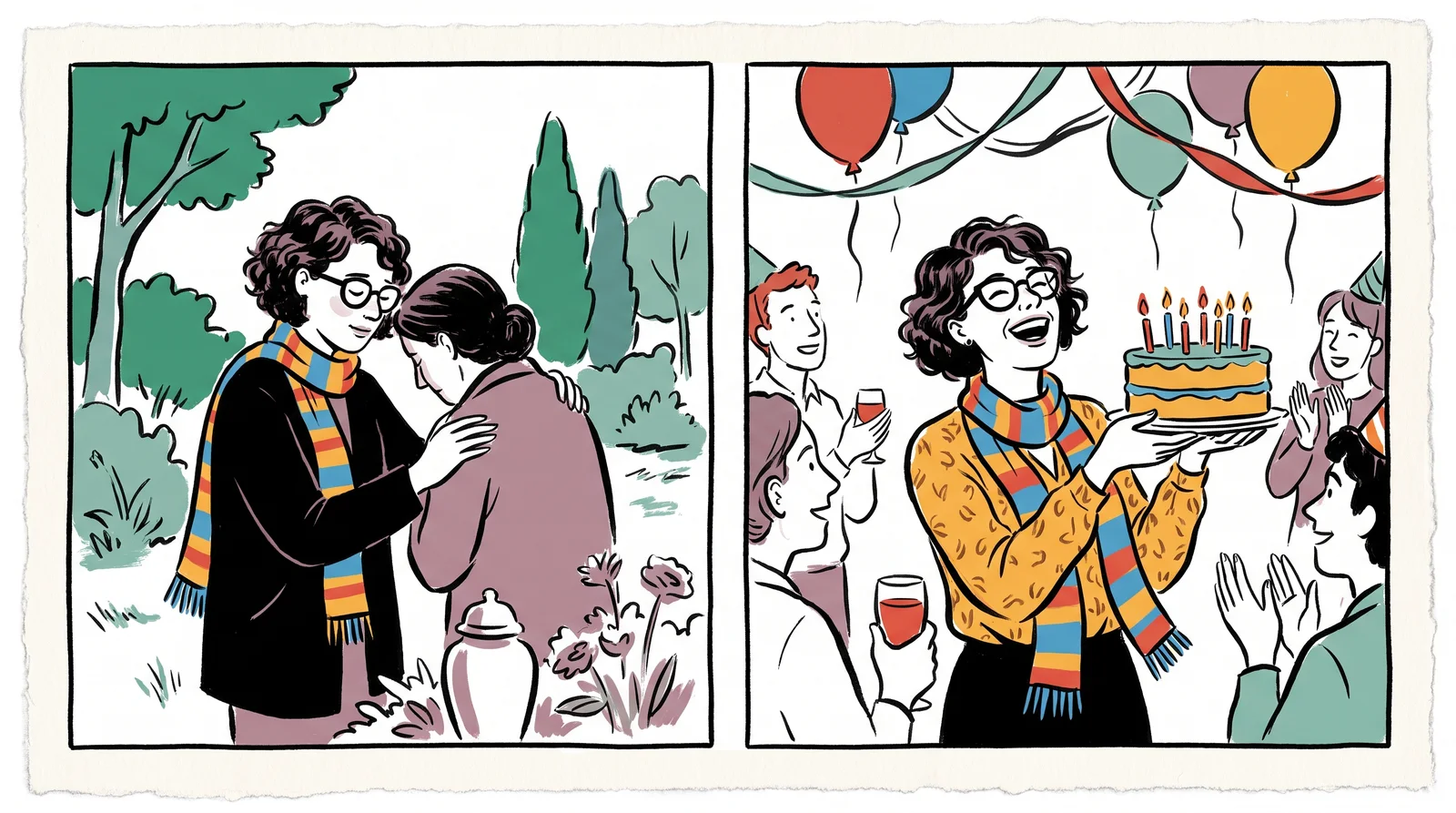
Every brand sounds like something, whether anyone chose it or not. is the part that stays the same wherever the brand speaks, and is how that voice adjusts to the moment, so that a refund email and a launch announcement sound related without sounding identical. Mailchimp's public content style guide puts it in one line, saying you have the same voice all the time but your tone changes. People do this without thinking. You speak differently at a funeral and at a birthday, and your friends still recognise you at both. A brand has to do it on purpose, across hundreds of writers who have never met.
Tone is easier to set with a few dials than with adjectives. In 2016 Kate Moran of the Nielsen Norman Group described four of them, formal against casual, serious against funny, respectful against irreverent, and matter-of-fact against enthusiastic. Her team then showed people versions of the same web copy written at different points on those dials. The ratings moved the way you would expect, with a funny, casual version rated friendlier and less formal than a serious one. The differences were small, around half a point to one point on a five-point scale. Only the words had changed. Of the four dials, formality usually carries the most personality.
Most voice guides go wrong on their first page, because they describe the voice with adjectives. A guide that says friendly, confident and human describes roughly every company that has ever existed, and it gives a writer nothing to do differently on Monday. The version that works is built from pairs and examples. Mailchimp's guide calls its voice plainspoken and genuine, with a dry sense of humour, and then says it is weird but not inappropriate, smart but not snobbish, which tells a writer where the edges are. The best guides then show the same sentence written two or three ways, with the reason one of them was chosen. The rewrite does the teaching.
The most useful page in any voice guide is the least glamorous one, the word list. It records the terms the brand uses, the terms it never uses, and what it calls the things it sells, its customers and itself. The GOV.UK style guide is the best-known public example. It tells government writers to avoid deliver, which it keeps for pizzas, post and services rather than abstract ideas, and going forward, because they are unlikely to be giving travel directions. A list like that settles more arguments per page than the rest of the document put together. New writers actually open it.
Tone is tested at the worst moments, so a professional writes those first. Anybody can sound charming in a launch announcement. The real test is what the brand sounds like in a failed payment, a delayed order, a price rise and an outage, because those are the messages customers read most carefully, and each one costs the reader something. KFC faced one in February 2018, when a switch of delivery company to DHL left hundreds of its British restaurants without chicken and forced them to close. Its apology was a full-page newspaper advertisement showing an empty bucket with the letters rearranged to read FCK, and copy admitting that a chicken restaurant without any chicken was not ideal. It was widely praised, and it suited a brand that already joked with its customers, so a joke at its own expense read as honest. A bank could not have run it. Write your four hard messages before the manifesto. A voice that cannot apologise without sounding either robotic or flippant is unfinished, however good the launch copy looks.
Stakes set the . Cheerful irreverence works for a company with nothing to lose and reads as evasion from one holding your money, while clipped institutional formality reassures in a bank and repels in a bakery. So a working writer sets the dials by asking what the reader risks in each situation, and ignores what amuses the team. The same brand can then be light and warm on its homepage and plain and exact on a bank statement, and still sound like itself in both places. Terms and conditions, price changes and account notices are where brands most often drop their voice altogether, and they are the places where a plain, clear sentence is most welcome.
Worked example
Write a working voice guide in an afternoon
- 01Collect thirty real pieces of the brand's writing, including an error message, a receipt, a complaint reply and a social post.The voice a brand actually has is in its everyday writing. Launch copy only shows the voice it hoped for.
- 02Mark where each piece sits on the four dials: formal or casual, serious or funny, respectful or irreverent, matter-of-fact or enthusiastic.Where the pieces disagree, the brand currently has no voice at all.
- 03Choose a default setting for each dial and write it as a pair, such as direct but never blunt.A pair shows a writer where the edge is. A single adjective does not.
- 04Rewrite four hard messages in the chosen voice: a failed payment, a delayed order, a price rise and an outage.These are the messages customers read most carefully.
- 05Keep the version you rejected beside each one you chose, with a line saying why.The comparison teaches faster than any description.
- 06Start the word list with twenty terms you use, twenty you never use, and the exact names for your products and your customers.It settles more arguments than any other page in the guide.
- 07Give the guide to someone who has never written for the brand, ask for a short email, and read it aloud to someone outside the company.Where the listener stops paying attention is where the guide still needs work.
The words, in plain language
- Voice
- What stays constant wherever the brand speaks. It does not change because the situation did.
- Tone
- What flexes. The same voice, adjusted for a refund email or a launch.
- Register
- How formal the language is. Usually the single setting that carries most of the personality a reader hears.
- Tone dimensions
- Four scales for describing tone: formal or casual, serious or funny, respectful or irreverent, matter-of-fact or enthusiastic.
- Lexicon
- The actual words in and out, including what the brand calls its products and its customers. The part of a voice guide people use most.
- Microcopy
- The small words in an interface, such as buttons, labels and error messages. Most of what a customer reads from a brand.
Why it matters
The commonest mistake is a guide made only of adjectives. Everyone agrees with it in the meeting, it feels finished, and it changes nothing anybody writes afterwards. Writers fall back on their own habits, so the brand ends up sounding like whoever wrote last, and a customer who reads the website, an invoice and a support reply meets three different companies. The cost is quiet. It shows up as a brand that never becomes recognisable in words, however much it spends on how it looks.
The second is not hearing your own habits. Every founder has verbal tics that leak into the brand, such as a favourite intensifier, a habit of hedging, or three adjectives where one would do. Read a page of your own copy aloud to somebody who does not work with you and watch where they stop listening. That is your register problem. A document that lists adjectives will not fix it, and a word list of the tics you want gone will do far more.
The third is treating voice as a marketing job. Most of the words a customer reads come from the product, the receipts, the delivery updates and the support team, and those are usually written by people who have never seen the voice guide. If the guide lives with the marketing team alone, the brand sounds considered in its adverts and careless everywhere else. Give the guide first to the people who write error messages and complaint replies. They need it most. Start with the ten messages your product sends most often, because those are the words most customers will ever read from you.
The rest of this module goes from principles to particular kinds of writing. It starts with how to write voice principles that a writer can act on, and with building the vocabulary list of words you use and words you avoid. Then it covers taglines and campaign endlines, and conventions for naming products so a range stays coherent. After that come , long-form brand writing, writing for packaging and writing for social media. The module ends with carrying a voice into other languages. Idiom rarely survives a straight translation.
Elsewhere
Reading
- Type
- term
- Period
- ongoing