Meaning and semiotics

Member lesson

Gestalt principles

Lesson 3 of 9 in Meaning and semiotics.

Gestalt principles | Processing the Environment | MCAT | Khan Academy · khanacademymedicine
Lesson

Gestalt psychology en.wikipedia.org started with Max Wertheimer, Kurt Koffka and Wolfgang Köhler in the early twentieth century, out of Wertheimer's 1912 study of apparent movement, where two lights flashing in turn are seen as one light moving across the gap. From it came a set of grouping principles en.wikipedia.org: proximity, similarity, closure, good continuation and common fate, sitting alongside figure and ground. The famous line about the whole being greater than the sum of its parts is a misquote. Koffka's version was that the whole is something else than the sum of its parts, because summing is a meaningless procedure.
proximitysimilarityclosurecontinuitythe eye groups before the mind readswhich is why a layout can say something the words do notspacing is an argument
Proximity, similarity, closure and continuity, each shown with dots.
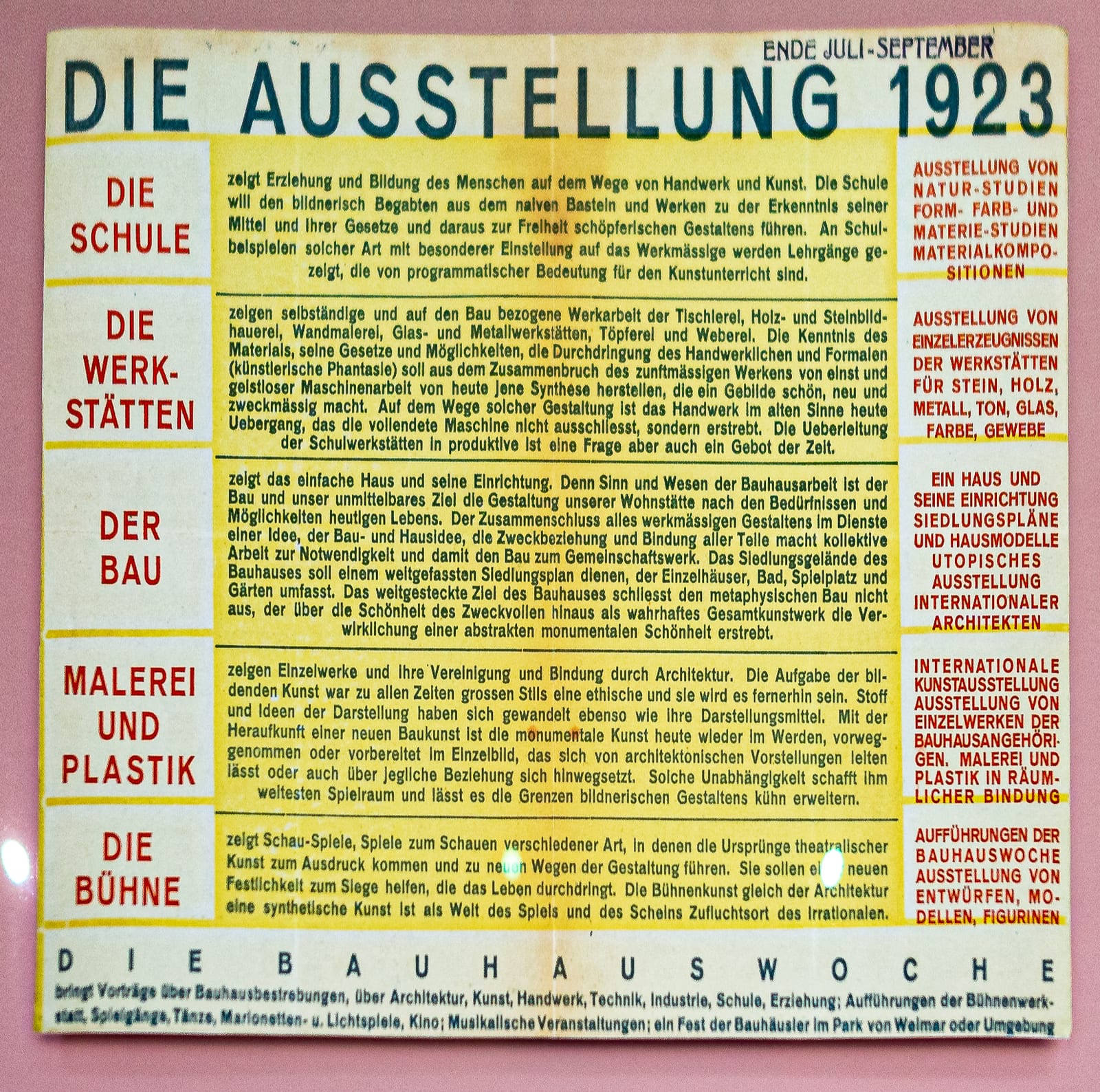
A printed sheet, photographed framed behind glass. DIE AUSSTELLUNG 1923 runs across the top. Below it a five-row table sets red category headings (the school, the workshops, the building, painting and sculpture, the stage) beside paragraphs of justified German text on yellow, with a second red column of listings down the right-hand side.
An advertising sheet for the 1923 Bauhaus exhibition. Red headings, a tight table and one sans-serif build a clear order with very few means.Advertising sheet for the Bauhaus exhibition, Weimar. Oskar Schlemmer, 1923.Wikimedia Commons/CC0 1.0
Member

The rest of this is for members.

You have read the opening of this lesson. The rest of it comes with a membership.

One membership covers all four courses and Brands.

  • All lessons in the four Learn courses
  • All brand breakdowns in the Brands section
  • All quizzes, flashcards and crosswords
  • An AI teacher on every lesson, for up to 60 questions a day
  • All course material published during the membership

Price

Membership is from $12 a month on the Yearly plan, which is charged at $144 once a year. Lifetime access is $59, paid once.Membership is from ₹200 a month on the Yearly plan, which is charged at ₹2,400 + GST once a year. Lifetime access is ₹3,999 + GST, paid once.

Check what stuck

Members only

You can't take this check yet.

Members answer these 3 questions and keep the ticket for this lesson. Every lesson has one.

  1. Question 1, locked

    Items placed close together are read as belonging together. Which principle is that?

    • Proximity
    • Closure
    • Continuity
  2. Question 2, locked

    Which of these words means this? “Things near each other are read as a group. The strongest of the principles and the cheapest to use.”

    • Signified
    • Signifier
    • Proximity
    • Sign
  3. Question 3, locked

    Which of these words means this? “The eye completes a shape that has gaps in it, which is why a mark can be drawn mostly by what is missing.”

    • Code
    • Connotation
    • Closure
    • Denotation

Elsewhere in the library

Hear about new courses.

Leave an email and we will tell you when something new lands. We do not write often.